

Desert Online General Trading LLC
Dubai, United Arab Emirates
Desert Online General Trading LLC
Dubai, United Arab Emirates

Full description not available
L**.
Contemplating life in a meaningless war
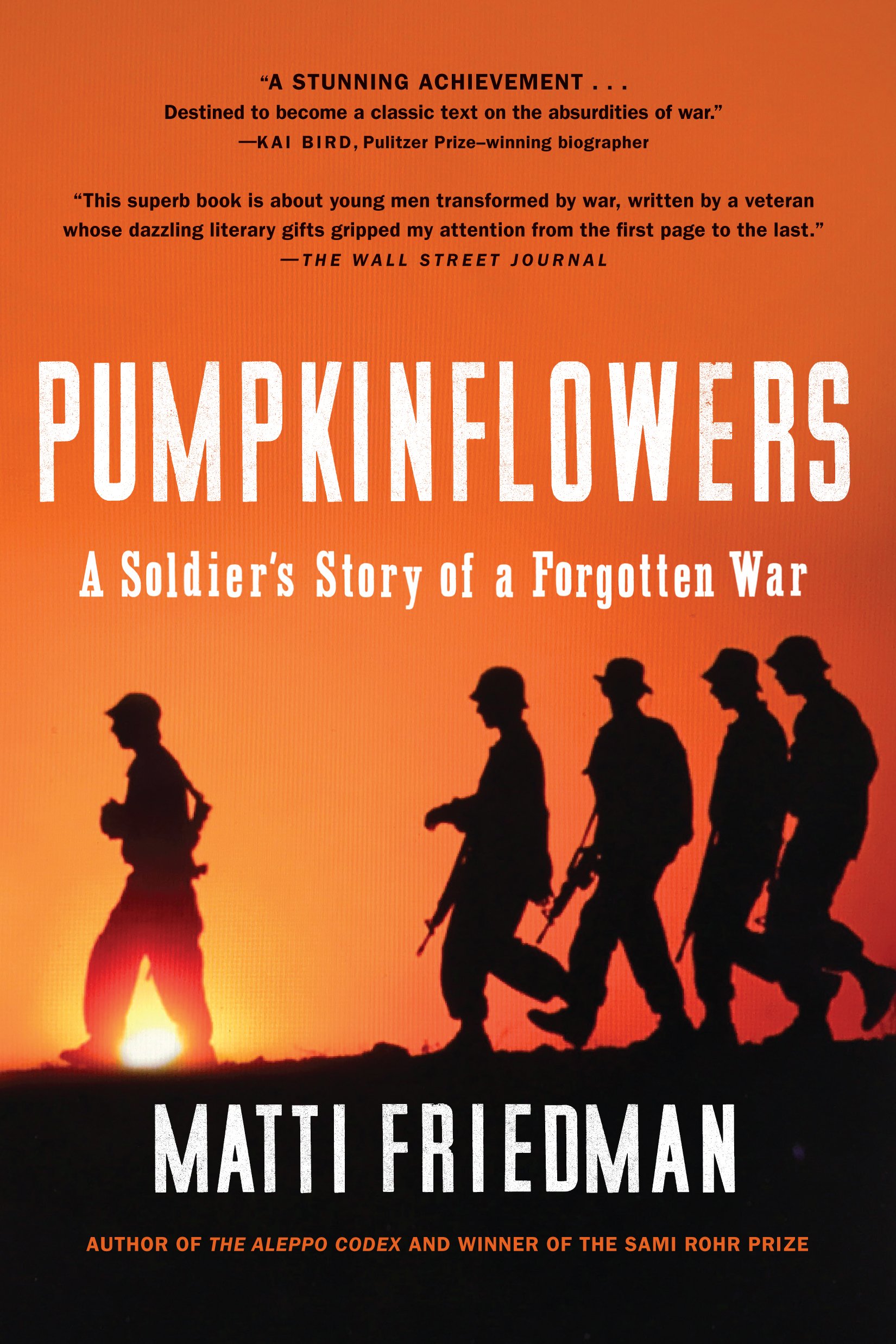
Matti Friedman’s Pumpkinflowers unfolds in the mid-1990s on a hilltop in southern Lebanon in the last years of the Lebanon war. Arriving there, young, inexperienced recruits like Matti are met with a constant threat from the missiles, mines, and snipers, the danger growing more pointless as the pullout is imminent. There is no combat-style battle, instead, Matti’s buddies are steadily wounded or killed in brutal and bizarre circumstances. What can one learn from such a harrowing experience?“Perception of the thinness of line between here and gone,” Friedman writes, “is the debt I owe that place, and the reason I am grateful for my time there."There are many similarly deep observations on life from someone who was facing death on a daily basis. While Friedman's political commentary on the events he had experienced feel somewhat dated today, his deeply personal account of engagement in a war that lost its meaning is profoundly moving.
J**L
One of the most thought-provoking reads of 2016
This is one of the best books produced in 2016. Matti Friedman writes about Israel, the Middle East, and the political and personal implications of war from a unique perspective. Born in Canada and an immigrant to Israel as a teenager, Friedman shares his skepticism towards Israel's military involvement in Lebanon. As a former combat soldier in the Israel/Lebanon conflict that occurred in the 90s and current reservist, Friedman honestly and poignantly paints a picture of a country whose attitude towards war and the military spans from the anti-war mothers of the kibbutzim, to the apolitical teenage soldiers who are performing their compulsory duties as members of a diverse set of troops, to right-wingers who justify war with keeping the country safe from terrorists. It is indeed a complicated country - and while all characters, including the author, share different views of militarism and war, all agree on one common goal: the survival of the world's only Jewish state.As Western consumers of news (whom Friedman is clearly addressing as his audience in this book), we are constantly inundated with images of the Middle East and Israel. Generally, progressive news outlets tend to view Israel's military operations unfavorably - that is, Israel's military tactics are generally criticized, and consumers of the news are not really getting the full picture of the Middle East in general, or Israel's relationship to it. Friedman also has a journalistic background and has covered Israel while working for the Associated Press. These experiences, while not mentioned explicitly in the book, I believe served as motivating factors for the subject matter of this text.The most powerful portion of this text (to me) was the last, when Friedman recounts a visit he took to Lebanon, where he was stationed whilst a soldier in the IDF. As an Israeli/Canadian dual citizen, he could only enter into Lebanon as a Canadian, and had to hide throughout his visit 1) his Jewish identity; 2) his Israeli citizenship; and 3) his service to the IDF. The most powerful part is when he was on his way to the Pumpkin (the outpost where he was stationed in the 90s) in southern Lebanon, and remarks that he "had traveled 12,000 miles (from Toronto) to arrive 20 miles from" where his family's home was located in northern Israel. This gives you a real sense of how serious (and sad) the divide of a border can truly be, especially in a place as volatile as the Middle East.
J**N
Real life account
I learned a lot about an important war in my country’s history that our nation does not even recognize as having been a real war. Well written. Hard to put down.
D**Y
Human Reflections Through the Lens of a Young Infantryman
Every word is carefully measured. Every short story that comprises this nonfiction work is thoughtful and considered. And several are as gripping as a jagged lightning bolt that splits the pitch-dark night sky. Authored by an Israeli-Canadian former combat infantryman and journalist, "Pumpkinflowers" provides seasoned reflections, layered with multiple meaning—about growing up, human friendships, serving in a remote military outpost, and witnessing powerful changes unfold in Israel and Lebanon in the 1990s and in this century, from both sides of an arbitrary security line. Most powerful of all are the “word-pictures” and “word-symbols” that Mr. Friedman paints and sculpts of the incredibly thin, almost imperceptible, divide between being alive and being dead, and friend and enemy—at both the individual and national levels. And you smell the dusty roads of northern Israel, and you see the gradual unfolding of a new Dawn of Readiness in the skies above the concrete and sandbags of the desolate “Pumpkin” outpost. This is not a work of weighty military strategies and sweeping geopolitical forces. Instead, what is most evident are the mundane moments, the shared sentiments, the fear, and the regular thoughts and feelings of young soldiers—those who lived, and those who did not. There are a number of times that the author includes verses penned by some of the famous poets of the First World War. "Pumpkinflowers," with its conservation of words, and the depth of impact and insight it conveys, is actually much closer to poetry than it is to prose. And all the better because of it.
A**E
A Touching Tribute.
A well written account of a forgotten war where young Israelis were wounded and died protecting the North of Israel in the buffer Zone between Lebanon and Israel in the nineties. At an out post called the Pumpkin Friedman describes the events over these years in simple but powerful language.Battling Hezbollah militants in a time when the 'suicide bomber' was yet to make a mark, the boys on the Pumpkin obeyed orders and wished for the normal life of a teenager. This story is a tribute to those boys, some of whom never returned to their families and a look at the political climate of Israel and the Middle East at the time.Israel is a country forever struggling to maintain their sovereign right to the land surrounded by hostile countries who would like to annihilate them.I can't imagine how it would be to live with the constant threat of rockets being fired over the border into the country and almost daily attacks on the population by suicide bombers and the like.I'm sure everyone would like to see peace in the area but that seems like a pipe dream with the ever growing threats and hostilities.
G**Y
Personal experiences..
I found too much dialogue related to the bureaucracy and foolish people in the militaryuppers.
C**.
Great book!
Very good book that shows the perspective of an Israeli soldier in an outpost in Southern Lebanon. The book is very well written and easy to read, I couldn't stop reading it at some points! It also has some interesting discussions about what is new Middle East and what it means to people from Western countries.This is one of the best books I read recently!
D**R
Touching, amazing and important
This is an Important piece dealing with an important period in Israel's history and it is doing with loads of understanding of humans and soldiers.
E**S
exotic ... sad ... well researched ... funny ... it has it all
This one is a nice, really nice, welcome change of pace from all the Iraq and Afghanistan books that have come out in the last 10/15 years in regards to ... well, to pretty much everything. It is also very different from the big picture stuff that studies the 6 days and Yom Kippur wars.So what is that you can find in this book and not in the aforementioned ones. Well, for starters this is a book narrating events from the 90s, and the author excels at giving plenty of pop culture references to that decade, be ready to revisit, or discover, some Backstreet Boys and The Cranberries songs.The book also explores and reflects on the dynamics of a conscripted army, which to boot has a really young officer corps. So there's plenty of what are the motivations of a conscript, a conscript of a "besieged" country, a conscript that may have been born in Israel or far away, a conscript that may or may not be a Jew.Also this is not memoir, it would be more apt to describe this book as "the tale of a COP" or stretching it as "the tale of the last days of the security zone" (that being the security zone inside Lebanon that the Israeli armed forces used to police). And to tell that tale the author includes his own experiences in the zone as a chapter, but also he has interviewed plenty of other veterans and civilians involved in the story which made up the other chapters.The book scores extra points for being written in a way in which each death comes as, not a surprise but, a shock. There's plenty of war books out there that when recounting the events make pretty clear what is coming and who is going to die, not this one, in this one even when you know that someone is going to die the final moment comes a shock.If you were born in the late 70s or early 80s the constant reflections of the author about how much time has passed since the events narrated will probably resonate with you.Finally, my only complaint is with the English used by the writer as it shows that he is more used to express himself in Hebrew ... but it more than makes up for it with his sense of humor ..."After rotating out of the line and boarding a civilian bus home a girl soldier would sometimes slip in next to me—a clerk or instructor coming from one of the safe bases inside Israel where such olive-drab unicorns roamed free,..."
P**M
highly recommended
A beautiful piece of literature. No matter where you stand on the debate. If you have a heart you will feel for the people involved in this unforgiving region.
Trustpilot
4 days ago
2 weeks ago