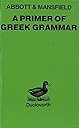
Primer of Greek Grammar
Product ID: 118540306
Desertcart purchases this item on your behalf and handles shipping, customs, and support to Croatia.
Primer of Greek Grammar
B**Y
A really excellent book and Primer
A really excellent book and Primer. 5 stars. So useful for Classical Greek and Homer as one cannot remember everything when translating. I knew it well, was as this is a replacement for a book used for over 30 years Brian.
P**C
Vital
Vital for embedding grammar
D**N
WHAT'S 'REGULAR'?
This appears to be the Greek grammar we used when I was at school, and I'm talking 50 years ago. In its smart modern paperback binding it looks a bit less forbidding, but there is nothing to suggest that it has been updated or revised in any way.I should think that anyone studying ancient Greek these days is studying it out of some real desire to know the language and its marvellous literature, not because it is an established part of the curriculum, which it isn't these days. There are, I would suggest, right ways and wrong ways of using this book. My idea of the right way is to do the unavoidable hard labour of learning the basic formations of Greek words, but to get into reading some real Greek as quickly as possible rather than trying to master every last nuance that you will find here. You can get a long way with Latin just by the old pedantic method of swotting up declensions and conjugations, but if you try to approach Greek in the same way you will very likely be dead having read no Greek worth reading before you get fully on top of it from that angle. Firstly, this book is full of verb-formations that you are never likely to see in a month of Sundays. Secondly, the verbs in Greek are all over the place - the number of verbs that could be called completely 'regular' in the Latin sense is minimal. Nouns and adjectives are easier in that respect, and a little bit of old-style hard slog will reward the effort over these.What the beginner in classical Greek needs above all is the right kind of teacher. Having mastered the unavoidable groundwork, the student needs to be shown as soon as possible how Greek actually says things, and that is where the real thrill begins to kick in. As the student begins to develop some confidence, this book will come to be more of a work of reference and less of a 'primer'. When the general sense of a passage suggests what some unfamiliar-looking verb-form might mean, the book can be used to confirm or falsify the suggestion. However to do that one needs to have an idea where to look in the first place, and it is a bit of a waste of this short life to try to learn, let alone memorise, anything and everything that one might possibly come across when a bit of familiarity with what Greek authors actually said can implant an instinct for the matter far better. Again, in the chapter on syntax the book knows and deploys the correct syntactical term for every kind of usage, no matter how ordinary the usage and how sesquipedalian the term. Some of the terms are genuinely useful and worth committing to memory, for instance the accusative of duration of time or the genitive of comparison. In other cases the Greek usage is no different from ordinary English usage - 'ponou mnemon' translates straightforwardly into English as 'mindful of toil' and I shall soon have forgotten that this is some 'genitive of reference'; and one thing that could really do with removing is the second example in section 8 on page 170 which purports to illustrate the use of two accusatives and contains only one.Commendably, there is a chapter on Homeric forms, which are a bit baffling to start with for a student whose first acquaintance is necessarily with Attic, the dialect spoken in Athens. This is somewhere again where good teaching and instruction are needed to give the student confidence. I remember L R Palmer in a lecture saying jokingly that in reading the Iliad once you have read the first 23 books the 24th is comparatively simple. In fact the situation is nowhere near as dire as that - the Homeric epics are built on formulae, and one can get used to those surprisingly quickly, but it's better to learn them directly and under guidance with this book as a reference only. In passing I was delighted to note that even at the time of first compiling this book the original editors were on the right side of 'the Homeric question', seeing the Iliad and Odyssey as the product of a folk-tradition and ignoring with disdain the despicable and sentimental English pretence to detect a single divinely inspired author through their own superior literary perception. Also useful to the student here is the identification of the 'digamma', a w-sound lost by the time Greek adopted alphabetic writing but essential to the understanding of scansion in Homer.Most pleasing of all are the last two words of the book. Following a particularly indigestible paragraph on Historic Principal Verbs and Primary Conjunctives, we find the wordsTHE END
B**B
Five Stars
Essential for classics degree.
S**R
The print could be better. The text ranges from photocopy looking to outright ...
For a primer book, it is very cluttered and confusingly laid out. The print could be better. The text ranges from photocopy looking to outright blobs which are in some cases illegible where the text is so small and because of the tiny accents Greek has.
S**R
Useful compact reference grammar
This is a reference grammar, not a course book. It is the classical Greek equivalent of Kennedy in Latin. Although I use other grammars, notably Smyth for his comprehensive coverage and the new Cambridge one for the explanations, A and M is worth having to hand if you just want to check a point. I managed to pick up a hardback, which is well printed and opens flat.
R**T
One Star
Exactly what we wantedABBOTT
A**R
Four Stars
Still getting in to it so can't really give a meaningful comment
Trustpilot
2 weeks ago
2 weeks ago