We remain fully operational. Our teams are working around the clock to ensure your deliveries continue safely.

DOWNLOAD THE APP


Customer Services
Copyright © 2025 Desertcart Holdings Limited
DOWNLOAD THE APP
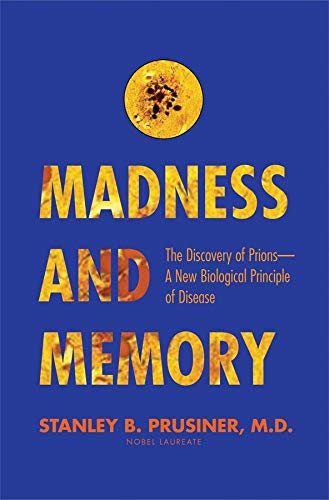
Full description not available
R**Z
An Interesting Mix of Biography and Biology
The brief family history that Prusiner includes at the beginning of this book will probably be enlightening, even for those who have read something about the history and treatment of the Jewish community in Europe. Some of Prusiner’s ancestors were forced to live “in the Pale,” so I learned one likely literal meaning behind the common phrase “beyond the pale.”The rest of the book is sprinkled with more autobiographical detail, especially relating to the antagonism that Prusiner encountered in the course of his advancement of prions as the source of many neuro-degenerative diseases.Readers might get somewhat confused reading about Prusiner’s research. The core of his discovery is that prions are proteins that replicate WITHOUT the use of DNA or RNA. But then after emphasizing how his researches were daily making it more and more clear to him that prions were indeed raw proteins without any hidden DNA – the reader will suddenly read about his efforts to find the potentially damaged/mutated DNA behind these proteins. What?Prusiner does eventually somewhat clarify what was meant by there being DNA behind the DNA-less prions. A particular genetic mutation in an individual, or the presence of a somewhat rare allele of a common gene – might make individuals more likely to produce some “precursor” proteins in their cells. Then when those precursor proteins come into contact with the misshapen protein that is a prion - a triggering effect takes place. Contact with the misshapen protein prion causes the precursor protein to also become deformed. In short, a prion is a bad influence, a kind of attractive juvenile delinquent that can infect a body. It causes the precursor protein chains it meets to similarly fold into rogue shapes. These malformed proteins then accumulate as plaques in neural pathways, leading to Creutzfeldt-Jacobs disease, mad cow disease, scrapie (in sheep), or other neuro-degenerative diseases.I just wish Prusiner had presented this kind of summary earlier or more clearly in the book. Then readers wouldn’t be left to wonder why they were suddenly reading about a search for bad genes when they had been emphatically told that prions are characterized by having NO genes, no DNA or RNA. It turns out it’s not any prion genes that were being sought.Then readers might encounter a few other snags reading this book. It’s not always easy going, although Prusiner usually makes the biochemistry as intelligible to the layman as possible. There’s a good glossary at the back of the book. There are also a variety of insets in the text, providing some basic information about DNA and various biological processes in order to bring readers up to speed.One stylistic snag is the presence of so many superficial descriptions of Prusiner’s colleagues. I notice that editors do tend to tell the authors of scientific works to humanize their subject matter by allowing readers to picture the various researchers as they pour over their test tubes. But Prusiner seems to approach this recommendation too eccentrically. He often and oddly focuses on his colleagues’ hair styles in the course of giving these physical descriptions. Over and over, we read on which side a researcher parted his hair. Enough already!Then Prusiner perhaps gets a bit ahead of himself when he says his research has given doctors “a new modality for treating neuro-degenerative disease.” I don’t think that has happened – yet.Overall though, this is an informative book on a fascinating subject. Readers will not only learn about prions, but they will also learn a lot about the process of doing research. They’ll read about the comparative advantages of hamsters and mice as test subjects. They’ll read about the process of getting grant money for research and about the often cut-throat competition to be the first one to announce a discovery and get the credit.However, I do think some additional reading such as “The Family That Couldn’t Sleep” might prove to be a good supplement to “Madness.” In ‘The Family…,” author D. T. Max presents a brief, but somewhat less glowing picture of Prusiner than he presents of himself. But the advantage of books such as Max’s are that they are more anecdotal. They bring the suffering experienced by animal and human victims of prion diseases home to the reader.
L**)
Interesting account of a "heretical" discovery
Stanley Prusiner won the Nobel Prize in Physiology or Medicine in 1997 for his demonstration that a unique infectious agent, which he called a prion (for “proteinaceous infectious particle”), caused certain neurodegenerative diseases in animals and humans. This book describes his discovery and attempts to persuade other scientists of its correctness, a very uphill battle because the idea of a protein that could reproduce itself without the involvement of any nucleic acid, the normal carrier of genetic information—let alone cause transmissible disease—went completely against the basic concepts of genetics and biology as they were known at the time. Controversy about the prion theory continued even after Prusiner received the Nobel, and some scientists still think it is incorrect, but most have come to accept it.Prusiner’s discovery of prions grew out of a hunt for the agent that caused a transmissible neurodegenerative disease in sheep, called scrapie because afflicted animals rubbed themselves raw against any available surface. When examined after death, the sheep’s brains were as full of holes as Swiss cheese. Prusiner believed that a rare human neurodegenerative disease called Creutzfeldt-Jakob disease, as well as another one found only in a Papua New Guinea tribe that ate deceased’ relatives brains as a way to honor them, were caused by a similar agent. The book describes his attempts to purify and identify this agent, using mice and hamsters as his test animals. He eventually showed that prions were pure protein, normal cellular proteins that had become able to reproduce themselves (by changing nearby normal proteins of the same type) and cause disease because of changes in their three-dimensional structure. In their misfolded form, they accumulated inside nerve cells and eventually destroyed them.Prions are worth reading about for more reasons than their challenge to standard theories of biology. Although the human diseases originally attributed to prions were rare, prions became headline news in the mid-1990s when a number of people, chiefly in Great Britain, developed symptoms similar to those of Cruetzfeldt-Jakob disease and were shown to have almost surely acquired the disease by eating beef from cattle suffering from bovine spongiform encephalopathy, commonly called “mad cow disease,” a bovine form of scrapie. A potential epidemic of “variant Creutzfeldt-Jakob disease” (variant CJD) was prevented by killing possibly infected cattle and banning the practice of including animal remains in cattle food. Fortunately, variant CJD disease has remained rare, though cases do still appear occasionally, according to the World Health Organization. In the meantime, however, a number of cellular proteins have been found to have regions susceptible to the kind of misfolding that can turn them into prions, and many researchers, including Prusiner, believe or suspect that the prion forms of such proteins cause or contribute to common human neurodegenerative diseases such as Alzheimer’s disease, Parkinson’s disease, and amyotrophic lateral sclerosis (ALS, or “Lou Gehrig’s disease”).Prusiner’s account of his research is a quite riveting scientific detective story. For the most part, I don’t think that people used to reading about biomedical research at the complexity level of, say, Discover magazine would find it hard to follow, though the last part, containing many alphabet-soup names for various genes and proteins, is fairly tough sledding. The book also gives a good idea of the personal rivalries and struggles for funding that play such major roles in modern science. Prusiner comes across as very single-minded and perhaps hard to get along with, but, as one supportive older scientist put it, he was no doubt “worth the prickles”; singlemindedness, after all, is a necessary characteristic if you’re proposing an idea as heretical as his first appeared to be.
J**R
Highly recommended
A really interesting book about the discovery of prions and the tough time that Pruisner got from fellow scientists who didn't believe it was possible to have an infectious Protein that replicated without DNA or rna. Highly recommended, even though it gets tough at times as he explains the experiments.
G**E
ein wundervolles Buch!
Für jeden der sich für Neuropathologie, Prionen, Alzheimer, Scrapie und creutzfeldt-jakob-krankheit interessiert ein tolles Buch.Die Leistungen von Prusiner sind nicht nur grossartig, sondern sie verändern die bisher angenommenen Mechanismen der Krankheitserreger vollständig!Ich bin gespannt was sich beim Thema Prionen noch so ergeben wird.Ein sehr gut geschriebenes Buch, schade, dass es nicht in deutscher Sprache erhältlich ist...
P**B
Bel libro
Il libro lo sta leggendo mia moglie, è molto interessante anche per il fatto che l'autore descrive anche tutto il contesto in cui il suo lavoro sui prioni si è sviluppato. Consigliato
H**E
The personal story of a major scientific discovery
If you ever wanted to know the background behind the discovery of prions, the infectious protein that causes "mad cow disease", this is the book you need to read.
M**R
Five Stars
excellent
Trustpilot
4 days ago
2 weeks ago