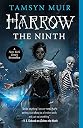

Harrow the Ninth (The Locked Tomb Series Book 2) - Kindle edition by Muir, Tamsyn. Download it once and read it on your Kindle device, PC, phones or tablets. Use features like bookmarks, note taking and highlighting while reading Harrow the Ninth (The Locked Tomb Series Book 2). Review: Not as "fun" as GIDEON, but more complex, stranger, ambitious - and just as good - I absolutely loved Gideon the Ninth, Tamsyn Muir’s “lesbian necromancers in a gothic mansion in space” story told from the perspective of a jock whose interest in the plot around her couldn’t have been less, and whose main concern was fitting with the cute women around her. Gideon had a wild story, one that involved an ancient puzzle, some horrifying uses of necromancy (lots of bones involves), a bit of an Agatha Christie murder mystery, and a climax that tied together a lot of the emotional beats that lays so quietly and subtly under the story. Now comes Harrow the Ninth, the second entry in a planned trilogy, which switches narration from the jock warrior Gideon to the young, crafty necromancer Harrow, who’s still reeling from the events of Gideon, and finds herself in a whole new hostile environment and trying to figure out her place in a whole new hierarchy. What unfolds from there gets…well, it gets complicated. Very, very complicated. And that’s without mentioning the alternating chapters that find Harrow remembering the story of Gideon the Ninth…except that Gideon’s not there, the characters aren’t quite the same, and the plot keeps diverging from our memories. Harrow the Ninth is undeniably dense and complicated, even without the weird questions of memory that those chapters bring up; add to that the shift from Gideon’s careless, simple narration to Harrow’s careful, secretive perspective, and you have a book that feels exponentially more challenging than the original. That goes for the plot as well; while Gideon had the hook of this strange gothic murder mystery, Harrow has all the scheming of Game of Thrones as people jockey for the favor of God (whose name might be John?), prepare for an apocalyptic threat, and bully Harrow and another newcomer into showing the powers that they need to display very quickly - oh, and no one (and I mean no one) is being honest about their motivations or even their actions. All of that can make Harrow the Ninth a bit less “fun” to read than Gideon, but it doesn’t make it any less enjoyable, stunningly imaginative, richly characterized, or compelling and gripping. If nothing else, Harrow kicks off the mystery early with this alternate version of the events of Gideon, but it won’t take long until you’re just as immersed into this weird relationship with God, the people around him, or the story of the one man who keeps trying to murder her in increasingly horrifying ways. Muir’s imagination is allowed even more free reign in Harrow than in Gideon; while the first book allowed us to see a truly wild version of necromancy and horrifying magic, Harrow takes it even further, creating spectral horrors, alternate dimensions of death, magic of wholly unexpected schools, and a whole lot of violence, all while developing her universe far beyond the limits of Gideon’s limited interest. In some ways, Harrow definitely feels like the middle book of a trilogy; while it’s entirely self-contained, you can definitely feel the threads being placed for what’s to come, and the end of the book sets up a third book that should just be a delight. But that doesn’t detract from any of the pleasures of Harrow the Ninth, whose writing is so good that the simple shift from second-person to first-person made me sit up straighter and gasp a little bit. Gideon is a blast, but Harrow might just be better for its complexity and ambition, and it’s all the better because Muir more or less nails it, taking on some astonishing difficulty curves and sticking the landing perfectly. What a joy this book is; here’s hoping that book three comes soon. Review: Not as good as the 1st, but still great. - Harrow was probably my least favorite character in Gideon the Ninth. So, I worried about a book solely based on a character who mostly acted like the foil for Gideon, but once wrapped my head around what the book was I liked it quite a bit. First the parts that might bug people. The books feel wildly different. The first book was basically a murder mystery book with space wizards. This book is a mystery, but more like Memento. A good story is made up of a main character who needs to go through some sort of personal transformation. The journey there is just how they navigate and address the things that help or hinder them. So, most of the world around the main character is more 2 dimensional. Like Memento you are drip fed things in portions of portions, but in Memento the main character is actively playing a part because he's trying to get to a known goal and the memory loss itself is a supporting character of sorts that he has to address. In doing so he goes through that transformation. Harrow is the exact opposite. She basically already went through the transformational journey, and spends most of the book being passively pulled back to that state with bits of the plan she already made being explained in the moment they are needed. What's even weirder is that it's not like her transformation comes through struggle. It's more like a child who is a blank slate growing into their personality, but one that is already predetermined. Needless to say, the book can feel very disjointed and like a novella that got stretched into a novel. As negative as that all sounds, by the end I appreciated this book. Any negative reactions I had were more from just how off the book feels after the first. It's like going to see a movie expecting a comedy and it turns out to be a good drama. Even though the movie was good you can feel a little disconcerted. This book ends up being a lot like the Silmarillion to the hobbit, or chronicles of Riddick to pitch black. The first story is very character driven in a much more isolated world, and then the sequel, or other book, spends the majority of the time expanding the universe instead of capitalizing on the existing characters. There really just isn't a sequel to Gideon the Ninth without expanding the universe. The world was too small for the characters to really grow. So this book is about world building and I felt that was done really well. The universe feels very unique and interesting, and opens up a lot of opportunity for what the 3rd book can be. I would guess that there was a bit of a kill your darlings situation with the first book where the extended universe was drastically cut to get to the meat of the story, and this was a book to get all that out. I'll also note that the story of Harrow is still good even if it is dragged out. The last 1/3 of the book is much better in this regard. So, I think the secret to enjoying this book is to understand that it is really two things put together. A really cool world building effort with a character story that's dragged out through the first 2/3rds and then really committed to in the end. I liked it by the end, but I would be disappointed if it doesn't get back to something more character driven in the 3rd. Also, I think this would have worked better as a couple of novellas.


| Best Sellers Rank | #15,287 in Kindle Store ( See Top 100 in Kindle Store ) #66 in LGBTQ+ Fantasy (Kindle Store) #118 in Space Operas #155 in Space Opera Science Fiction (Kindle Store) |
J**E
Not as "fun" as GIDEON, but more complex, stranger, ambitious - and just as good
I absolutely loved Gideon the Ninth, Tamsyn Muir’s “lesbian necromancers in a gothic mansion in space” story told from the perspective of a jock whose interest in the plot around her couldn’t have been less, and whose main concern was fitting with the cute women around her. Gideon had a wild story, one that involved an ancient puzzle, some horrifying uses of necromancy (lots of bones involves), a bit of an Agatha Christie murder mystery, and a climax that tied together a lot of the emotional beats that lays so quietly and subtly under the story. Now comes Harrow the Ninth, the second entry in a planned trilogy, which switches narration from the jock warrior Gideon to the young, crafty necromancer Harrow, who’s still reeling from the events of Gideon, and finds herself in a whole new hostile environment and trying to figure out her place in a whole new hierarchy. What unfolds from there gets…well, it gets complicated. Very, very complicated. And that’s without mentioning the alternating chapters that find Harrow remembering the story of Gideon the Ninth…except that Gideon’s not there, the characters aren’t quite the same, and the plot keeps diverging from our memories. Harrow the Ninth is undeniably dense and complicated, even without the weird questions of memory that those chapters bring up; add to that the shift from Gideon’s careless, simple narration to Harrow’s careful, secretive perspective, and you have a book that feels exponentially more challenging than the original. That goes for the plot as well; while Gideon had the hook of this strange gothic murder mystery, Harrow has all the scheming of Game of Thrones as people jockey for the favor of God (whose name might be John?), prepare for an apocalyptic threat, and bully Harrow and another newcomer into showing the powers that they need to display very quickly - oh, and no one (and I mean no one) is being honest about their motivations or even their actions. All of that can make Harrow the Ninth a bit less “fun” to read than Gideon, but it doesn’t make it any less enjoyable, stunningly imaginative, richly characterized, or compelling and gripping. If nothing else, Harrow kicks off the mystery early with this alternate version of the events of Gideon, but it won’t take long until you’re just as immersed into this weird relationship with God, the people around him, or the story of the one man who keeps trying to murder her in increasingly horrifying ways. Muir’s imagination is allowed even more free reign in Harrow than in Gideon; while the first book allowed us to see a truly wild version of necromancy and horrifying magic, Harrow takes it even further, creating spectral horrors, alternate dimensions of death, magic of wholly unexpected schools, and a whole lot of violence, all while developing her universe far beyond the limits of Gideon’s limited interest. In some ways, Harrow definitely feels like the middle book of a trilogy; while it’s entirely self-contained, you can definitely feel the threads being placed for what’s to come, and the end of the book sets up a third book that should just be a delight. But that doesn’t detract from any of the pleasures of Harrow the Ninth, whose writing is so good that the simple shift from second-person to first-person made me sit up straighter and gasp a little bit. Gideon is a blast, but Harrow might just be better for its complexity and ambition, and it’s all the better because Muir more or less nails it, taking on some astonishing difficulty curves and sticking the landing perfectly. What a joy this book is; here’s hoping that book three comes soon.
F**K
Not as good as the 1st, but still great.
Harrow was probably my least favorite character in Gideon the Ninth. So, I worried about a book solely based on a character who mostly acted like the foil for Gideon, but once wrapped my head around what the book was I liked it quite a bit. First the parts that might bug people. The books feel wildly different. The first book was basically a murder mystery book with space wizards. This book is a mystery, but more like Memento. A good story is made up of a main character who needs to go through some sort of personal transformation. The journey there is just how they navigate and address the things that help or hinder them. So, most of the world around the main character is more 2 dimensional. Like Memento you are drip fed things in portions of portions, but in Memento the main character is actively playing a part because he's trying to get to a known goal and the memory loss itself is a supporting character of sorts that he has to address. In doing so he goes through that transformation. Harrow is the exact opposite. She basically already went through the transformational journey, and spends most of the book being passively pulled back to that state with bits of the plan she already made being explained in the moment they are needed. What's even weirder is that it's not like her transformation comes through struggle. It's more like a child who is a blank slate growing into their personality, but one that is already predetermined. Needless to say, the book can feel very disjointed and like a novella that got stretched into a novel. As negative as that all sounds, by the end I appreciated this book. Any negative reactions I had were more from just how off the book feels after the first. It's like going to see a movie expecting a comedy and it turns out to be a good drama. Even though the movie was good you can feel a little disconcerted. This book ends up being a lot like the Silmarillion to the hobbit, or chronicles of Riddick to pitch black. The first story is very character driven in a much more isolated world, and then the sequel, or other book, spends the majority of the time expanding the universe instead of capitalizing on the existing characters. There really just isn't a sequel to Gideon the Ninth without expanding the universe. The world was too small for the characters to really grow. So this book is about world building and I felt that was done really well. The universe feels very unique and interesting, and opens up a lot of opportunity for what the 3rd book can be. I would guess that there was a bit of a kill your darlings situation with the first book where the extended universe was drastically cut to get to the meat of the story, and this was a book to get all that out. I'll also note that the story of Harrow is still good even if it is dragged out. The last 1/3 of the book is much better in this regard. So, I think the secret to enjoying this book is to understand that it is really two things put together. A really cool world building effort with a character story that's dragged out through the first 2/3rds and then really committed to in the end. I liked it by the end, but I would be disappointed if it doesn't get back to something more character driven in the 3rd. Also, I think this would have worked better as a couple of novellas.
J**D
Plods for too long, but goes out with fireworks
More than halfway through Harrow and I was ready to give the book three stars. Harrow follows directly from where Gideon ended, but is written very differently. Most of the book takes place on a space station, the Seat of the Emperor. There are only six people there: The Emperor, Harrow, Ianthe, and the Emperor’s three remaining Lyctors, Mercymorn, Augustine and Ortus. However, there is something wrong with Harrow; making her an “unreliable” narrator who is blindly following instructions she has left for herself, written in her own hand. I’m not the biggest fan of narration by possibly insane characters, but it was an even bigger struggle here because Muir chose write nearly all the book in second person point of view. I completely understand why she chose to do so – the style suits the story being told. I still hate it. It’s an awkward POV and makes it easy to forget who the events are happening to. The waters are muddied further by the fact that some alternating chapters go back to the events of the first book, but those events are now different. I figured out quickly what was happening, so it felt like a lot of time – too much time – was spent unnecessarily “rewriting” history until the big reveal of why Harrow came to be like she is. The plot did not advance for far too long. Nevertheless, I read the book almost straight through because of the worldbuilding. Readers get a bit about the Great Resurrection through which the Emperor saved humanity, much more information about the planet revenants that are hunting the Emperor and a whole lot on necromancy. I enjoyed how Muir’s necromancy is treated more like a science, with expertise in various disciplines (bone magic, flesh magic, spirit, etc.) I like the new Lyctors. And frankly, I absolutely loved the Emperor Undying/God. He is fascinating and his interactions with Harrow and the rest of the characters are the highlight of the book. The book jumped from three stars to five solely because of the last third (and that scene with the soup, omg!). When Muir begins to tie all the threads together, when the plot against the Emperor is revealed, when we see what Harrow set in motion, who is in the Locked Tomb – I could not put the book down. The conclusion, while something of a cliffhanger, was excellent. I still feel too much time was spend on Harrow’s “madness”, but the story toward the end fulfilled the potential of book one so that I cannot wait for the finale, and more John.
A**N
A dense, quasi-impressionist attempt at world-building...
First, I'm a 62-year old technical guy. I've been a science fiction reader my whole life and when I read the description of 'Gideon the Ninth' as 'Lesbian necromancers explore a haunted gothic palace in space', I WAS THERE. Mind you, I cut my teeth on E.R. Burroughs, Clark Aston Smith, Frank Herbert, S.R. Delany, and Lovecraft, so world-building genre mashups are kind of my thing. And I do okay with uncertainty in story development (I prefer my books and movies to answer 9 out of 10 questions, as opposed to 11 out of 10...). Anyway, Gideon the Ninth was a great read. Its prose was fairly dense (which I enjoy), with thematic elements that reminded me variously of Peake's 'Gormenghast' trilogy, C.A. Smith (especially 'Zothique' and 'Xiccarph'), with even a bit of Chip Delaney's 'Dhalgren' thrown in. The front end is kind of missing some exposition that would have gone a long way toward helping less patient readers get their bearings, but the story eventually develops into a coherent, if slightly patchwork, narrative. As mentioned in the headline, I consider Muir's world building technique to be almost impressionist. The use of humor throughout also worked, although I think that Ms. Muir should have stayed more in the world of her own creation rather than relying on early 21-century English idioms (Think of it this way: 10,000 years from now, language, and especially English, will be very different from what it is now. If you're going to build a world, own it, including the language your characters use. You can still use the Queen's English to make the story understood, but just pepper it up with its own flavoring. One well-known example of this is Burgess' 'A Clockwork Orange'.) Would I call it a YA or 'coming-of-age' story? No. The main characters, although young, are not children. As recently as 100 years ago, young people were called upon to shoulder adult responsibilities and make mature decisions (Kind of shows you how far we've fallen, doesn't it? Thank you, DoEd.). The characters in Gideon are raised in similar environments with similar expectations. And they all understand that, in the universe of Gideon, mercy is a pipe-dream. Overall, I enjoyed it. It did have a few minor niggles, but worked for the most part. Tamsyn Muir is a definite talent to watch. Highly recommended. BTW, I've started 'Harrow the Ninth'. If you've read or are reading 'Gideon', here's my one word review: Disorienting. (But definitely stick with it.)
K**R
A book you'll reread the moment you finish
I loved this book! Better than Gideon the Ninth, though they're very different books, so it's hard to compare them. Gideon was a mystery with an irreverent tone, Harrow is more of a horror thriller where the narrator's unreliability is thrown in your face from the word go. But both exist in a wonderful, rich, dark world, and both are beautiful character studies of profoundly broken people. Muir's characters feel like whole people, with their own histories, public personas, and hidden depths. We get a good look at old, old friends and old, old enemies, and how the two are sometimes the same. Muir's writing remains excellent, and on top of that she does the best job I've ever seen of portraying a character whose perception of reality is not quite aligned with the genuine article (this isn't a spoiler - it becomes clear almost immediately that this is the case). Even though the tone is far darker than Gideon, it's peppered with a number of wry jokes and some references to memes - but this latter is done subtly and almost never feels out of place. Additionally, Harrow answers basically every question left dangling in Gideon, while introducing its own fun crop. Reading this book will make you want to reread Gideon, and then reread Harrow again right after. In fact, I reread Gideon in anticipation of the book dropping, and then I read Harrow, then Harrow again, then Gideon again, and now I'm starting Harrow again. This book has layers upon layers, with seamless call-backs to the previous book on things you didn't realize were foreshadowing at the time. I can't remember the last time I liked a book this much (as evidenced, perhaps, by the fact that I'm reading it 3 times in a week).
L**E
SO unique, but a challenging read
This is really a 3.5 star review, based on the content + price. I finished the book. I liked it. I liked it enough that I will likely buy the next book (the writing style really is first-class -- well beyond a 5-star rating -- like, best I've read in years amazing). But I'm hoping the author is more gentle on her readers in book 3. Help us out a little more -- we're reading this for pleasure, not an English Lit class. I want to give the next book a 5-star review. I decided to round down in my Amazon rating because this book was expensive & ultimately, I felt let down. Detailed Review: I love the author's creativity and style. Her writing is visceral AND overly-educated: it's the perfect combo of mind/body. I have a huge vocabulary & still learned new words. After starting this book, I stopped after a few chapters & went back and re-read Gideon because it had been too long since I read the first one & I was lost. After re-reading Gideon, I was still confused & that's when I realized that something bigger was going on. There is a completely alternate reality that the MC remembers. If you aren't fresh on book 1, you need to go back so that the dichotomy between the two is apparent. The author is hard on her readers -- for the first 75% of the book, I was often lost. I really wish this part of the book had been condensed. For me, it wasn't necessary to force us to experience all of this confusion. I finished the book and even more than Gideon, I still don't fully understand the plot of Harrow. The fact that I couldn't follow the action made it a difficult read. The end of Gideon was like that, where lychtorhood is obtained & there's the dramatic fight conclusion ... I didn't fully grasp everything going on, but it didn't matter, because I got the gist & the love/sacrifice/etc. made the actual action-sequences almost irrelevant. But here, there's SO MUCH I didn't understand. This is kind of like James Joyce in a sci-fi/fantasy setting -- quite the literary read. But my literary tastes run more to Fyodor Dostoevsky & Henry James, so this was too meta for me. The characterization of Gideon rings so true/real, but Harrow was so difficult to connect with -- in part by design, but in part, because I'm not sure the author loves her as much as she loves Gideon. (Remember how I said the author's style was first-class -- check out the 2nd person narration in select chapters -- AMAZING! But it took me 1/2 the book to understand whose POV I was experiencing.). I didn't get Harrow's self-hatred when I should have -- that had to be pointed out by other side-characters. This flaw was there in Book 1, too -- but you don't get that as much because we're so thoroughly sunk into Gideon's POV. The best scene in the entire book for me was in the aftermath of Harrow cooking soup. All the emotional resonance I wanted was there. The sparseness of explanation & the sudden simplicity was BRILLIANT. All in, I spent too much of the book in a confused haze, so couldn't enjoy this as much as the first book. As a work of literary fantasy -- hats off! But I think the author has veered too far on the Joyce-side of writing & I worry that Book 3 will be a DNF (did-not-finish) for me if it's as challenging as this one.
B**Y
A disorienting ride, but WORTH IT!
If anyone found Gideon to be confusing, Harrow the Ninth is doubly so. I found about the first half of the book to be incredibly disorienting and confusing to read. Eventually it does all make sense, but it takes awhile to get there. This is the sort of book that I would probably enjoy more as a re-read, knowing what's going on and being able to pick out hints and clues, but initially it was quite frustrating. Especially because, as someone who LOVED Gideon as a character, I really missed her voice. This is the sort of book I can't say much about without spoiling it, but expect it to be disorienting and try to stick with it. Once things come together, you may realize that many of the choices the author made are actually quite smart. It's told in two timelines. One is present (although even this kind of skips around sometimes) and is written in second person. One is past and written in third person. I think that adds to what is already a bit confusing, but I do think there's a good reason for it. There is a mystery element here as you try to figure out what's going on, and you will again get plenty of necromancy in space, body horror, and graphic violence. We also get a lot more clues to the world-building, what's going on, and how we got where we are. You meet the older Lyctors and the Undead Emperor or "god", and this is definitely playing with our ideas of deity and the intersection of magic and science. As in book 1, there is lots of casual queerness, but this is in no way a romance. It's sci-fi horror with queer protagonists. There is some humor, but I definitely didn't find it as entertaining as book 1 when everything was filtered through Gideon's POV. While I found the first part of this book difficult to get through (for reasons stated above) I did end up liking it and will be reading on in the series. I will say, I definitely thought it was too long. There are a number of scenes that don't feel necessary to the narrative or feel too long. And maybe if I do a re-read more of that will make sense, but I still think this should have been shaved down by a good 50-100 pages. Gideon was a favorite for me last year, and Harrow made me realize how much the POV character really made book 1 for me. I liked and appreciated, but did not love this installment. But it is incredibly nuanced and inventive and the sort of thing that has re-readability. Thanks to the publisher and Libro.FM for providing me with (physical and audio) copies for review. All opinions are my own.
C**E
Complex, Original, Amazing
I did not know it was possible to love the Locked Tomb series any more than I already did after Gideon the Ninth, but here we are! This book does a fantastic job of making you think you possibly had a stroke while reading the 1st one. We have flashbacks that are not any where close to the 1st book, characters are mysteriously missing, and Harrow's memory is completely shot. But then we find out we have the world's #1 most unreliable narrator in Harrow! And the pieces all fall into place, what happened and what is happening. I will warn that the book can be confusing due to this and we jump around timelines a bit but just keep reading - it will all make sense. This book of course does not have the same tone as the first, but that was expected for me - Gideon and Harrow could not be more different. This book really solidifies our knowledge about the Emperor, what the Lyctor's actually do for him, and what/who Blood of Eden is/are. The additional story at the end "As Yet Unsent" really helped fill in missing pieces about BoE as well. I am so excited to read Nona and see where this story goes. The plot is utterly massive (love it, obsessed) and all the characters are well fleshed out (even the baddies). I am obsessed with this world, I love it. It's so original, I've never read a series like this before. I will definitely be re-reading and then will be massively depressed until the 4th book is released!
Trustpilot
2 months ago
2 days ago