Desert Online General Trading LLC
Dubai, United Arab Emirates
Desert Online General Trading LLC
Dubai, United Arab Emirates
Full description not available

S**E
Frequently referenced … wish I read it years ago
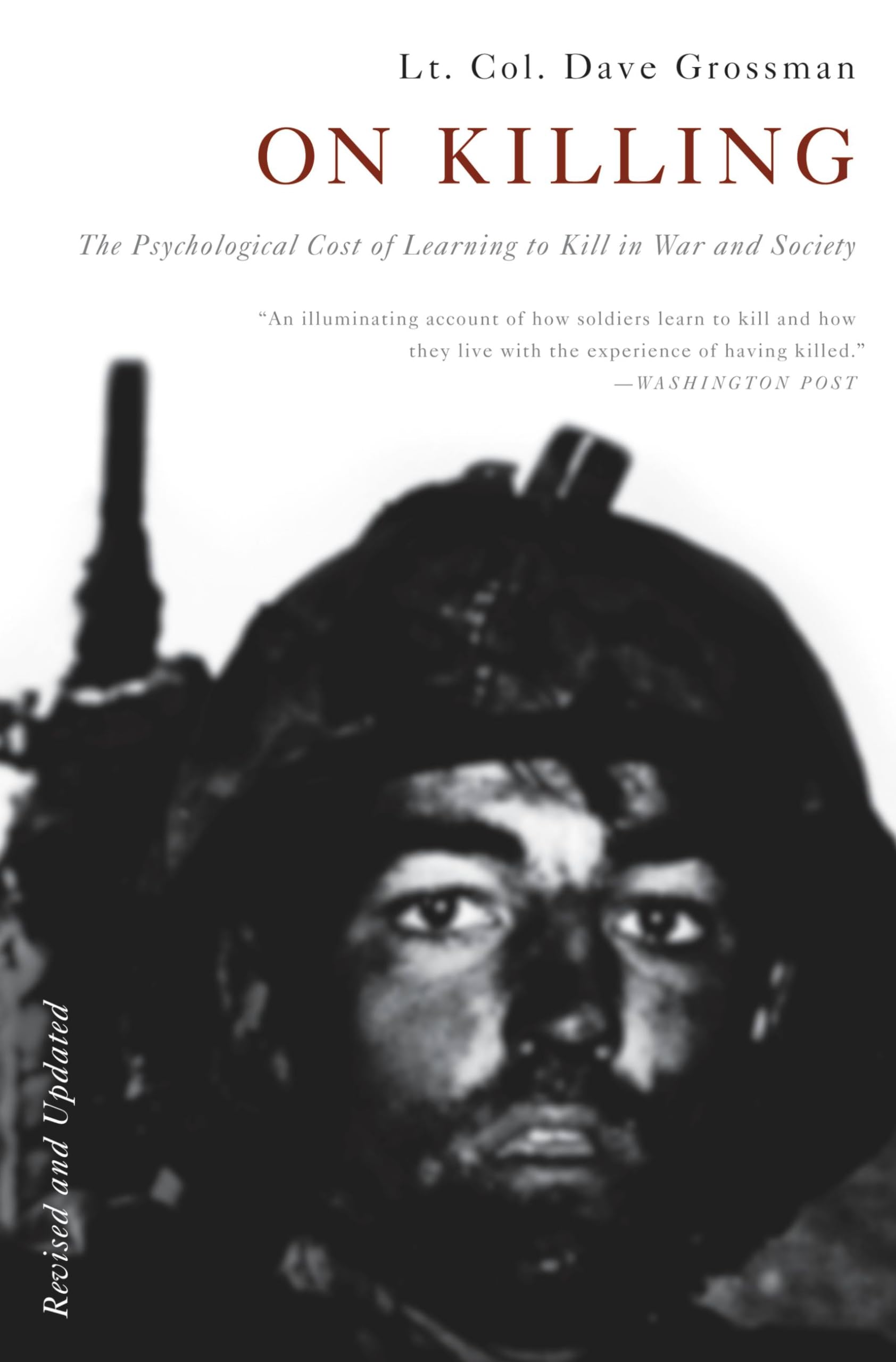
The book is so old and so frequently referenced that I finally read it. It's different. I was surprised. It reads like it's written at a 10th grade reading level from the beginning. Lots of random and wandering thought lines are anchored in massively-funded and easily externally referenced material to dispel doubt, nearly two centuries of military research, 18th -20th century foxhole hearsay somewhat updated with 21st century PTSD science. The book gets past the basic writing to grow into a considered writing. The concepts and mind imagery raises the book to an intense mind fertilizer read. Read a bit and sleep on it. It creeps into your mind as it should."On Killing" describes in visceral detail a mental conditioning phenomenon. My 40-some years of defense R&DTE experience runs directly and indirectly through the subject.The narrative converges on a seeming constant summed up with the long studies that normative conscript and basically trained citizen soldier translates to ‘80-90% of front line combat shooters don't shoot’. They may in fact be unable to kill another human being. Is there a deep subconscious rejection to killing that cannot be trained out? The phenomenon has been observed for 300 years and well documented between even the most desperate belligerents.The writers and amenders here compare very long-term rifle range 'marksmanship' scores with long observed battlefield kill statistics ... 80-90 out of 100 shooters, all with 10 for 10 scores on the firing range can be predicted to not shot in combat or intentionally shoot high. Up to 1000 shots per kill from a trained army have been observed on the battlefield even against closely spaced bayonet charging enemies. The civil war should have been predictably many times more lethal if combatants actually shot. WWI should have demonstrated the highest lethality of any war before, but casualties were in fact statistically lower than major medieval battles. WW2 may had the worst shooter marksmanship disparity between range accuracy to 100M vs actual <25m kill rates. How can it be that automatic single serve weapons have not been conclusively demonstrated to be more battlefield lethal than 18th century Prussian single shot muskets? Training evolved accordingly.Begin with the data ... 10-20% of rifleman will kill. 80-90% won’t. The squadron level soldiers are shown to know the killers from the non-shooters. A squadron battle order is collectively and perhaps without discussion resolved by its members. Members know who a reliable shooter is and who is not. Non-shooters are accepted, not rejected by squad members. There is no apparent squad level dishonor in not shooting in the heat of battle. The non-shooters will earn their keep and lose their own lives more frequently than squad shooters to ensure the killing shooters survival and rate of fire. The squadron shooters will abide by the collective arrangement. An unspoken equilibrium emerges among squad members.Crew served weapon shooters are savage killers. Collective killing dynamics are far different than the rifleman dynamics.Grimly, how can it be that a ‘firing squad’ member can exit 5-years of battlefield firing squad duty to describe the experience of never shooting a convict? Why do firing squad records reflect a progressive inaccuracy of shots on target? How could it be that some recorded firing squads required three or more attempts to execute the convicted? Here is a deep, dark human psychology primer. "On Killing" forces unanswerable questions on the reader … is PTSD more prevalent among shooters or non-shooters? Is the high rate of vet suicide a function of killing or a breakdown from not shooting? How much PTSD is the result of self-loathing or deep regret for not shooting when comrades and the battle demanded it? Is special forces training designed so rigorous in an attempt to separate shooters from non-shooters from among the general infantry population? Here the modern training regimen has reversed and changed the shooter from non-shooter.Tough, intense questions from such a short read. "On Killing" will most assuredly affect your military and history thinking. The authors here focus understanding around the killing dimension.The book is a thoroughly adult read I think. Young adults headed for the police or military career should read it. Concealed carry citizens should read it. Here be thoughts that might save your own life.
A**Y
A fascinating study
ON KILLING is the study of what author Lt. Col. Dave Grossman has termed "killology". This odd term describes, not killing between nations, but the exact circumstances involved when one individual ends the life of another individual, with the primary focus being on combat situations. I've sometimes wondered how I (someone who has never been anywhere near armed conflict) would fare on the frontlines, as killing another human being seems like an almost impossible psychological task. As Grossman casts an eye over historical reports of combat, he found that, apparently, I wasn't alone in thinking that. During the First and Second World Wars, officers estimated that only 15-20 percent of their frontline soldiers actually fired their weapons, and there is evidence to suggest that most of those who did fire aimed their rifles harmless above the heads of their enemy.Grossman's argument is carefully researched and methodically laid out. He begins by filling in some historical details, discussing the statistics for shots fired per soldier killed for the World Wars and the American Civil War. It's a refreshing and enlightening look at war that dispels a lot of misconceptions. An average solder in those wars was extremely reluctant to take arms against fellow humans, even in cases where his own life (or the lives of his companions) was threatened. Not to say that any of these people are cowards; in fact, many would engage in brave acts such as rescuing their comrades from behind enemy lines or standing in harm's way while helping a fellow to reload. But the ability to stare down the length of a gun barrel and make a conscious effort to end a life is a quality that is happily rare.The book continues on then, detailing what steps the US Army took to increase the percentage that they could get to actually fire upon their enemy. By studying precisely what the soldier's ordinary reactions were, the officers were able to change the scenario of war in order to avoid the most stressful of situations. The soldier found up-close killing to be abhorrent, so the emphasis was countered by inserting machinery (preferably one manned by multiple soldiers) between the killer and the enemy to increase the physical and emotional distance. Every effort is made to dehumanize the act of killing.Grossman spends a great deal of time discussing the trauma that the solder who kills faces when he returns to civilian life. Nowhere is this more apparent than in those veterans who returned from Vietnam. Those soldiers had been psychologically trained to kill in a way that no previous army had gone through, and there was no counteragent working to heal their psychological wounds. Grossman takes great pains to discuss how horrifying the act of killing is, and points out how detrimental it is to one's mental health. When the Vietnam veterans returned home to no counseling and the spit and bile of anti-war protestors, the emotional effect was astounding. Most of Grossman's thesis is supported by in-depth interviews and psychological profiles, but it is the story of the Vietnam veterans that comes across as the most disturbing.Much of the chatter about this book seems to revolve around the final section, the discussion about our own civilian society. While this is understandable, I actually preferred reading the earlier portions, simply because they opened my eyes to a lot about the military that I had been previously ignorant of. I think it would be a mistake to concentrate solely on the argument's conclusion as it rests heavily on the case that has been building. In any event, the book eventually develops its final conclusion: the methods that the military uses to desensitize its soldiers to killing are also being used in our media, but without the proper command structure that keeps people from killing indiscriminately. In a military situation, firing a weapon without proper authorization or instruction is a very serious offense, and this is drilled into the mind at the same time as the desensitization. Without this safety, there is nothing to hold back the killing instinct, and this is one of the main reasons why the homicide rate has increased so dramatically.Now, I'll say right off the bat that I was partial to this line of argument before I read the book; I think that children repeatedly exposed to such images would almost certainly become blasé towards extreme violence. But Grossman's book gave me so much more to think about. It isn't just a Pavlovian force at work here; Grossman points out many reasons (both stemming from society and the changing family structure) for why young people of today seem much more able to kill than their parents and grandparents were.I was honestly surprised at how strong of a writer Grossman is. He manages to put forth his argument without boring the reader. By its very nature, a lot of what he discusses is repetitive and disturbing, but the subject matter is so compelling that I didn't mind. Grossman is very logical in his approach and his argument is a powerful one. I highly recommend this book, especially for people like myself who have never experienced war at close quarters. The summary I (and others here) have given is simply not nearly adequate to capture all of Grossman's thorough contentions. ON KILLING made me think harder about a subject that I hadn't given a lot of thought too before. The information and research here is invaluable.
Trustpilot
2 weeks ago
1 month ago