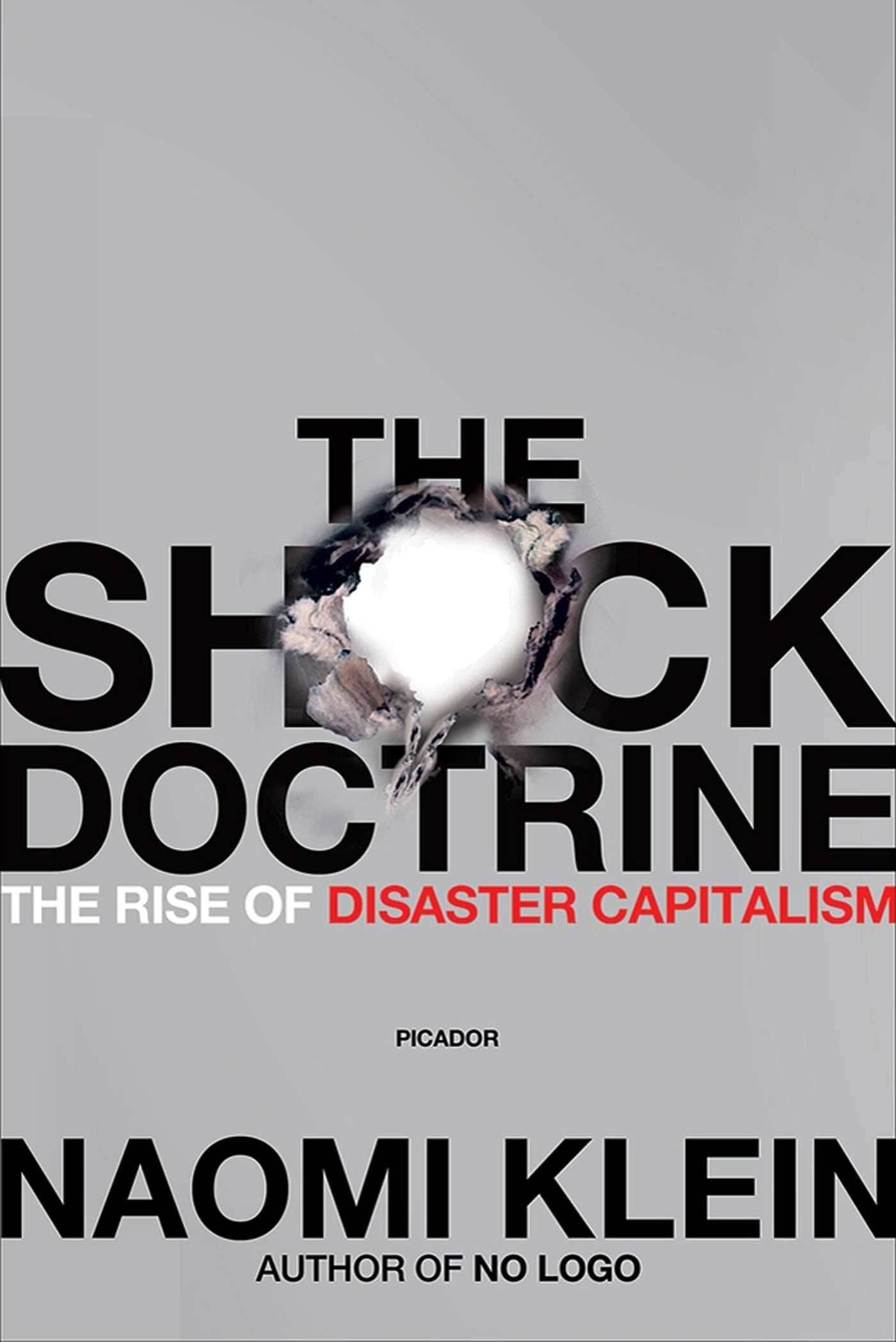

The Shock Doctrine: The Rise of Disaster Capitalism
Product ID: 1705066
🌍Global case studies from Chile to Iraq
📈Top #4 in Iraq History & Global Politics
🔥4.7/5 star rating from 3,575 reviews
Desertcart purchases this item on your behalf and handles shipping, customs, and support to Croatia.
📚 Dive into the economics behind global crises before everyone else does!
The Shock Doctrine by Naomi Klein is an international bestseller and award-winning exposé revealing how neoliberal economic policies exploit disasters worldwide. With a 4.7-star rating from over 3,500 readers, it critically examines the rise of 'disaster capitalism' through global case studies, challenging the myth of peaceful free-market triumphs and spotlighting the violent economic transformations post-crisis.


| Asin | 0312427999 |
| Dimensions | 5.92 x 1.8 x 8.29 inches |
| Edition | First Edition |
| Isbn 10 | 9780312427993 |
| Isbn 13 | 978-0312427993 |
| Item Weight | 1.22 pounds |
| Language | English |
| Print Length | 720 pages |
| Publication Date | June 24, 2008 |
| Publisher | Metropolitan Books |
User
The Shock Doctrine: A Great Examination of the Role of Economics, Politics, and Globalization
NOTE: this review only covers Part 1 - Part 5In The Shock Doctrine, Naomi Klein surveys the rise of and subsequent use of the "shock doctrine" as a method of instilling neoliberal policies into the governments of various countries from Chile to Russia. She traces the birth of this doctrine, its relation to shock therapy, and the way countless economics, dictators, and other officials have attempted to craft a new world order that never went according to plan. With a definite bias, Naomi Klein makes no apologies for her views, yet as radical as some might interpret her to be, she presents a compelling view of this political and economic philosophy that certainly resonates with current events, particularly the earthquake that devastated Haiti earlier this year.If there is one figure at the heart of Klein's narrative of neoliberal ideas it is Milton Friedman, the figurehead of neoliberalism, a man who counseled various foreign leaders in their attempt to implement the shock doctrine. The primary aim of the shock doctrine is to "shock" the economy of the country by drastically changing key policies that align with the neoliberal agenda. Most often, these times of drastic imbalance follow an uprising, coup, war, or the like. In this state, the citizens are already feeling a sense of distress and therefore, any additional shocks to the economy should not be a major issue. So, what Klein is attempting to do is to show that capitalism is not born of freedom and that "unfettered free markets go hand in hand with democracy" (pg. 22), but instead to challenge that "official story of capitalism" by demonstrating that capitalism, "has consistently been midwife by the most brutal forms of coercion, inflicted on the collective body politic as well as on the countless individual bodies" (pg. 23). Whether or not one subscribes to the beliefs of Naomi Klein, she does propose a very convincing look at the ways economics and political intertwine on a global scale.Beginning with the links between shock therapy and the shock doctrine, Klein basically suggests they work the same, both are aimed at erasing a "memory" if you will, to create a clean slate. In shock therapy, a new set of behaviors may be imprinted, in the shock doctrine, a new set of economic policies is to be enacted, specifically neoliberal policies - free trade, deregulation, privatization, etc. The chapter on this relationship between the two actually works to shock the reader, to show how unscrupulous these doctors were in trying to treat their patients, and these same doctors were coincidentally enough government funded for the most part.Without going into too much detail, subsequent chapter discussed the way the shock doctrine was executed (or attempted) in countries around the world; Klein uses Chile, Poland, South Africa, Russia, and China as prime examples. Each case follows a similar trajectory with a leader or faction in power that a certain cabal of insiders who wanted to shock the countries political and economic systems until they were replaced with neoliberal ideas, policies, and practices. In Chile, probably the best example from the book, a group of Chilean students taught at the University of Chicago (home to a neoliberal contingent of economists) formed a group called "The Chicago Boys," and these men infiltrated government positions and advised the military leaders who were planning a coup to force the president out of power. This scenario was repeated in several different incarnations around the world; Klein shows how governments from Communist to Democratic were all injected with a neoliberal agenda and how shocks in all the examined countries facilitated the changes that were to be necessarily to support a change. All cases, although very similar, are not always the same as the case of Russia and China illustrate. As these countries seemed to be transforming into democratic countries, underlying this adjustment was the shock doctrine, which was exercised differently than it was in the cases of the Latin American countries. Interestingly, as was the case in South Africa, and an example that stands out slightly, although Nelson Mandela and the ANC (African National Congress) came into power, their control over South Africa was more than show than an actuality. The men - white Afrikaners that had been in power for decades - continued to control the country's politics and economics behind the scene. But in all of these examples, the main point is that government coups, backhanding dealings, and other shady transactions were carried out to impose a new rule of law - that being neoliberalism.Part Five and one of the most interesting and compelling sections deals with the shock doctrine in the United States. Here, Klein weaves together the conjunctures between all the Bush era players, Bush Jr., Cheney, Rumsfeld, etc. and shows how each of these men had all the money in the world to gain from privatization efforts pre and post 9/11. The figures that Klein quotes Rumsfeld and Cheney making in their business ventures are mind boggling, and only reinforce the Bush administration's need to want to impose their own form of shock doctrine. What is most frightening about these figures is the example of Rumsfeld who was Chairman of Gilead Sciences, the company that patented Tamiflu. In other words, in any disaster where large quantities of Tamiflu were needed, and while people were suffering, Rumsfeld and the company would being doing financially well. Although this whole section was a little too "conspiracy theory" for my personal liking, Klein does you make one think more about the implications of those government officials being tied so closely to large for profit corporations.Overall, The Shock Doctrine is well researched, clear, well written and most of all a very, very compelling read. If you agree with Klein's views, you will love this book, if you are more of the neoliberal and conservative variety, you will probably not enjoying reading it and will certainly disagree with Naomi Klein and what she has to say. Overall, I think no matter one's political or ideological leanings, The Shock Doctrine makes the point of how tied together we are in a globalized world. Globalization does not just affect politics, economics, culture, or society. It doesn't just affect material goods, but it influences the way we all live our lives in the twenty-first century. As many reviewers have stated already, this book is eye opening, yet it offers the hope that maybe if we all become a little more educated about what is going on in the world, we could do something more to change it to the way we see fit.
User
Shockingly Powerful
The late Milton Friedman, the renowned economist, believed that democracy and a free-market economy went hand-in-hand, that the greatest threat to both was nationalization, government regulation, and social spending. He preached this philosophy to his disciples at the University of Chicago School of Economics, and they would go forth spreading the Gospel according to the Book of Milton.There is also the International Monetary Fund, an agency founded after World War II to help struggling countries and their economies get back on their feet. Many of its managers and policy makers will be graduates of the Chicago School of Economics, and they will begin to impose the Friedman creed wherever possible.There is only one thing wrong. No population seems to vote in the people who support their brand of economics. Its first success is when a socialist, democratically elected President of Chile, Salvador Allende, is overthrown and killed when the presidential palace is stormed by fascists. Augusto Pinochet comes into power and immediately places the "Chicago boys" in charge of the economy. With the death of price controls and lunch programs, Chileans find themselves spending one quarter of their monthly salaries just to buy bread. They will leave hours earlier for work than usual because they can no longer afford public transportation. Even Chile's social security program, once a model of efficiency is privatized, becoming virtually worthless overnight. Chilean children begin fainting in school from lack of food or milk and many stop attending altogether.The story of Chile will be repeated in Argentina, Bolivia, China, Peru, Poland, South Africa, Sri Lanka, and Russia where the IMF will demand that borrowers meet Draconian conditions before they lend money. In each case these austerity measures will be made overnight, all at once. A shocked population will come to their senses if such radical changes are made over time. They will be able to organize, mobilize and challenge the implementation of such policies. It has to come all at once, right after elections, a coup, or a hurricane when the population will be too dazed and disorganized to respond. This will be the shock, or as author Naomi Klein calls it, shock doctrine. For those who are still lucid, there is the next step in the shock doctrine, terrorize, torture, or make them disappear.In each case, in each country, prices on food and other common items will go through the roof, the number of destitute will increase exponentially, and democracy will be squashed. In China, the communist elite will impose these changes on the masses while ensuring that they will profit handsomely from the economic and social upheaval. President Clinton will cheer the economic shock doctrine instituted by Boris Yeltsin as he dissolves the Court and the Parliament, bringing the Russian army out to attack the latter, which killed more than 300 people and several deputies. A new class of super mega apparatchiks will emerge increasing the divide between the "have mores" and the "have nothings," and Russians will put up with a few KGB murders and disappearances for the promise of stability that Vladimir Putin will provide.The Polish people, fed up with the broken promises of Solidarity who succumbed to IMF demands to relieve them of their crushing debt, will be thrown out of office in 1996 elections. Nelson Mandela will focus so much on achieving political control of South Africa he will neglect the real political power of controlling the economic engines that run the nation. He soon discovers that without economic power, he has no political muscle. He becomes a slave of economic apartheid. Shanty towns will get larger and people will become poorer. The population is disillusioned with their new-found "equality." The tsunami in Sri Lanka will allow the hoteliers to make a deal with the government, and place security guards around the beaches of what once belonged to villagers who fished from there for hundreds of years. After all, what right did they have to be there? Besides, the smell of fish made their guests complain. They will be driven inland where they will be given boats and houses, just no access to water to fish.But that could never be allowed to happen here, or could it? One of the first things President George W. Bush does after he finally realizes what happened in New Orleans after Hurricane Katrina is remove union wage scale that contractors would have to pay to laborers. (After all, it is the corporations that must benefit the most from disaster capitalism, not the people of New Orleans). The shock has begun as developers are already seeing how they can take over the utterly destroyed neighborhoods of the poor and turn them into luxury condos and hotels. Charter schools are replacing the public schools and teachers. Contractors will wake up illegal laborers in the night to tell them that the Immigration officers are coming to arrest them. They will run away without having been paid. The Federal Emergency Management Agency, once a functional, effective, national emergency response unit, has had so much work farmed out to contractors, it cannot mount an effective response to the disaster. They will pay top dollar for roofing that can be done at a fraction of the cost. They will supply trailers for homeless that are made of material unsafe to breathe, and people will die in a stadium because no one can take care of them.In Iraq, the local population rose up after our invasion and began to elect their own leaders and councils. They announced plans to take over city governments, services and industry. When Iraqis were asked what they wanted more of when surveyed, they clamored for more government jobs. But L. Paul Bremer wasn't about to allow democracy to get in the way of disaster capitalism. He ordered the military to disband all local democratic initiatives, which he replaced with a council not chosen by the Iraqi people, but by him.George Bush talks democracy (in Iraq), but walks capitalism by performing a Marshal Plan in reverse. The original plan implemented right after World War II called for keeping foreign investors out of Germany. Our government wanted the Germans to be able to build up their own industry and wealth. Not so in Iraq. Unemployed and starving Iraqis watched how American contractors brought in cheap Asian labor to rebuild their country. Iraqi unemployment remains at approximately sixty percent. American oil companies and American banks make long-term contracts with the new Iraqi government, and the IMF wants Iraq to sell off its own oil industry to foreigners. The second largest military commitment in Iraq, after the Americans, will be mercenaries.Does anyone wonder why there is an insurgency? "No 'capitalization' without representation!"The author makes it clear. In every country that holds free elections, no one votes for the shock doctrine of disaster capitalism. No one will vote away social programs, controls, or selling off their industries and companies to foreign investors. Klein's conclusion? Capitalism and democracy are not inherently compatible as Friedman always believed. It was just the opposite.This book is powerful and moving. As I reread my review, I feel I have not done her book justice in relating the power and depth of Naomi Klein's words. Her documentation is exceptional. Her ability to craft together different events and present them in a coherent and believable hypothesis is necromantic.Once in a while you find a book, a special book, one you keep as a reference, a "go-to" one. This is such a text. It is one of the two most important I have read for 2008. I have enough admiration for this woman's work that I would buy anything she writes, without hesitation. Her writing will hold your attention."The Shock Doctrine" is eye-opening and of course, absolutely shocking.July 14, 2008Bastille Day--How Appropriate.
User
The elephant identified
I've read dozens (hundreds?) of books about what went wrong during the Bush administration (as well as books about what's continued to go wrong under Obama too). Some books are about specific things such as the Iraq war or GITMO. Others look at more overarching themes such as executive power or disregard for the rule of law. Most of such books have made some important points and contributed some valuable analysis, but I've usually been left feeling like the blind men arguing over what they've discovered. "It's a rope," says one. "No, it's a wall," says another. "You're both wrong, claims the third, "it's a tree trunk."Naomi Klein's "The Shock Doctrine" is the first book that correctly identifies the elephant. Now, perhaps Ms. Klein doesn't have the elephant quite right - maybe her elephant's ears are a tad too large, or perhaps its tail is a bit too short, but overall, she has described the elephant remarkably well.Following an introduction, Klein opens with the story of Dr. Ewen Cameron, a psychiatrist who believed that in order to "heal" his patients, he first needed to destroy their dysfunctional personality structure and "regress" them back to infancy in order to create a "clean slate" upon which to build a new, healthy personality. To accomplish this, he used a barrage of "treatments" from psychoactive drugs to extreme doses of electroshock therapy to sensory deprivation for weeks or even months at a time. The only problem, of course, is that he never successfully re-created fresh, healthy people - all he did was traumatize people and leave their old selves virtually destroyed.Now, it may seem a bit of a leap from one obscure Canadian psychiatrist to the global wave of "shock and awe" which has escalated especially in the last decade, but Ms. Klein has followed the trail carefully and plausibly. One of the first and most important stops along this trail is the economist Milton Friedman, the godfather of the "Chicago School" system of supply-sided free market capitalism.Friedman and his followers believe that if only there were purely unregulated, completely free markets, all or nearly all world problems would correct themselves through market "signals". Friedmanites believe that most if not all problems result from government regulations which distort the markets and confuse the signals. Their problem, especially during the height of New Deal Keynesian economics, was that no purely free market existed anywhere. In language eerily reminiscent of Ewen Cameron, Friedman wished to create a "clean slate" upon which "healthy" capitalism could be built.The next problem, however, was the pure capitalism was (and remains) deeply unpopular and, hence, difficult to implement in a democratic state. It turns out, fancy that, that given the choice, people *want* their government to protect them from rapacious corporate interests. The "Southern Cone" region of South America exemplified this problem. Having recently broken away from European colonial powers, nations like Chile and Argentina began building "developmentalist" economies - basically capitalistic economies protected by government regulations. Furthermore, these developmentalist economies were by and large successful. And wildly popular.The Friedmanites initially tried to overcome developmentalism (note, despite the rhetoric, the concern was never about communism) by sending hundreds of Chile's brightest students to study economics at the University of Chicago. These "Chicago Boys" were to return home and implement their newfound knowledge. But they weren't taken very seriously back home, since developmentalism was still in full-swing.Their chance came with the brutal and bloody overthrow of the democratically elected Salvador Allende by the U.S. backed Augusto Pinochet. In correspondence with Pinochet, Friedman urged Pinochet to use the window of opportunity created by the shock of the violent overthrow to implement "shock therapy". While the country was still reeling, and while dissidents were being actively and publicly silenced, Pinochet opened up nationalized companies to foreign private investors at fire sale prices. He repealed trade restrictions which resulted in a flood of cheap foreign goods which put many local companies out of business. In the name of "austerity" and reducing debt, he cut back on social programs for the poor and very young and old. Most Chileans were too busy trying to survive and put their lives back together to protest. Those who did tended to mysteriously disappear or simply get executed on the spot.Of course, even with the markets thrown wide open, the markets did not correct the ills of the country. In fact, things got significantly worse until some of the worst of the abuses were halted and some basic regulations restored. Meanwhile, over half of Chile's population descended into poverty and destitution.In country after country, Klein details how the same basic patterns repeated over and over again, with variations to account for the learning curve of the Chicago Bys and the different initial circumstances of each country. Indonesia, Argentina, Uruguay, Poland, Russia, South Africa, China and Iraq all experienced variations of "disaster capitalism" following (or during) wars, coups or revolutions, often in direct opposition to what the revolutionaries were fighting for. Time after time, nationalized industries were ripped from the people and pillaged by foreigners while governments cut back on aid to their own people. Time after time free market capitalism was implemented by brute force and shock therapy because it could not be implemented by democratic vote.Even the "developed" nations were not immune to the assault by the Chicago Boys. Both Margaret Thatcher in Britain and Ronald Reagan in the U.S. were ardent admirers of Milton Friedman, but both knew that they couldn't get away with what Pinochet and Suharto had. But both found their openings to begin making lasting changes - Thatcher used the Falkland's war while Reagan used the air traffic controllers strike, among others.Klein also shows how disaster capitalism gets implemented after natural disasters. Fishing families swept from their villages by the 2004 tsunami returned to find their beaches closed to them but wide open for luxury hotels and tourist resorts. Refugees from 2006 Hurricane Katrina returned to find no effort to rebuild their public schools, but charter schools already infested the city.Klein's book is a searing indictment of Milton Friedman and his followers, their morally bankrupt economic philosophy and the wide spread pain and suffering they have caused. This book is a must-read for anyone who wonders how we got where we are now. How it is that in the richest nation on earth, upwards of 10% of the population is unemployed, more than one in four children is food insecure and 49 million American don't have basic health coverage, while the top 1% own fleets of cars and boats and even entire islands.My only disappointment with the book is that it was published in 2007 - just before the Great Recession. I hope that Klein comes out with a follow up soon. In her final chapter, "Shock wears off", Klein talks about a number of hopeful signs, many coming from the first countries to be shocked and awed. It is her belief that as shock wears off, people become shock resistant and once more able to fight back. Perhaps that's what we're seeing with the Occupy movement.This far-reaching, wide-ranging and hard-hitting tour de force is also extensively documented in 100+ pages of end notes plus several asterisked footnotes. This book should be required reading for every high school and college economics class, if not for every American. I can't recommend it highly enough. Amazon only allows five stars, but I give it ten.
User
Shock therapy is rapid imosition of harsh market reforms on a population too stunned to resist after political or other disaster
The Shock Doctrine Book ReviewThe author strikes at the heart of market fundamentalists’ claim that freedom and democracy are the hallmarks of deregulated capitalism. Instead, she presents market fundamentalism as a far reaching ideology that has some surprising similarities to Twentieth Century communism. These include a strategy for world-wide dissemination, implementation by extensive coercive violence in much of the world, and marked indifference to suffering imposed undemocratically on the masses. But unlike communism, market fundamentalism is presented as a cynical war by the rich against the middle class and poor that inevitably leads to extreme concentration of riches in the hands of the few who can then capture government to perpetuate their dominance.The rise of the modern version of market fundamentalism began in the 1950s with Milton Friedman and others at the Chicago School of Economics. This was a counterrevolution to the successful Keynesian mixed economies of the time that relied on markets for growth but employed government regulation and taxation to counter market excesses, failures, and inequalities. The Chicago School regarded these government actions as distortions of the purity of markets according to their closed-loop thinking that relied on mathematical equations and models but very little real-world evidence.Friedman laid out the neoconservative economic agenda in 1962 in Capitalism and Freedom: First, governments must remove all rules and regulations standing in the way of the accumulation of profits. Second, they should sell off any assets they own that corporations could be running at a profit. And third, they should dramatically cut back funding of social programs. This became the well-known formula of deregulation, privatization, and cutbacks. The many specifics included low taxes for the rich, no worker protections like unions and minimum wage laws, no regulation of business, and elimination of government support for health care, pensions, and education.Implementation of this agenda in western democracies was difficult for the obvious reason that it required the majority to vote against its own interests to favor the rich. For equally obvious reasons, there was no shortage of plutocrats who provided overwhelming financial support for this agenda by extensive funding of lobbying, political campaigns, numerous think tanks, and media propaganda, particularly in the US. Consequently, gradual change was achieved, particularly beginning with Reagan and Thatcher, so that since the 1980s inequality has increased markedly in the US as nearly all economic gains from rising productivity have gone to the rich. Nevertheless, this transformation has been regarded as too slow, messy, and incomplete.In countries outside of the western democracies, many much swifter transformations to deregulated markets have been achieved by the strategy the author calls the shock doctrine, usually with disastrous consequences. In 1962, Friedman observed that “only a crisis—actual or perceived—produces real change.” He added that it was vital to keep his agenda alive and ready for rapid and irreversible implementation after political or natural disasters when populations were still too stunned to resist the “bitter medicine” that was to follow. He coined the phrase economic “shock treatment” for this painful tactic. The author reports three distinct phases of that shock treatment that follow in rapid succession: (1) the shock of the coup itself, (2) the shock of severe recessions with massive unemployment, falling wages, lost savings, and lost social insurance, and (3) the shock of imprisonment, torture (often featuring electric shock), and death for many tens of thousands who resisted.The mechanism to get Friedman’s agenda in place began with the Chile Project launched in 1956. This project brought 100 Chilean students to graduate school at the University of Chicago from 1957 to 1970. In 1965, the program was expanded to include students from across Latin America. As a result, hundreds of Chicago School economists along with some from other institutions were ready and waiting throughout Latin America and eventually throughout the world to administer shock treatment when opportunities arose. This program was greatly amplified by the International Monetary Fund (IMF) and World Bank in 1989 by adoption of the Washington Consensus for a similar market fundamentalist reform package for developing nations.From 1964 to 1985, numerous government crises, many of them after US-sponsored military coups, provided the opportunities for shock treatment throughout Latin America in Brazil, Chile, Argentina, Uruguay, and Bolivia, as well as in Indonesia. In 1989, the fall of the Soviet Union brought the opportunity for shock therapists to manage the sudden transition to market economies in Poland, other Soviet satellites, and finally Russia itself in 1991. Eventually other crises were exploited elsewhere, such as in South Africa during the change from apartheid, Thailand, South Korea, the Philippines, and Indonesia (again) after the 1997-1998 Asian financial crisis, war-torn Iraq immediately after the US invasion, Sri Lanka after the catastrophic 2004 Asian tsunami, and in New Orleans after Hurricane Katrina.The severe recessions that followed in many countries had drastic consequences for the general public. These included loss of fragile local industries and massive bankruptcy of farming after withdrawal of protection, rising unemployment up to 30% or more, falling wages by as much as 40%, increases by tens of millions for people living in poverty, and enhancement of this suffering from simultaneous withdrawal of social programs. Once the harsh impact of these policies became apparent, they became extremely unpopular and had to be implemented by force.Particularly in Latin America, military juntas engaged in book burning, closure of newspapers and magazines, occupation of universities, imposition of curfews, banning strikes and political meetings, raiding union halls, jailing community workers and union leaders, and deployment of tanks against demonstrators. The worst countries resorted to widespread torture and targeted extrajudicial killing, such as with the 300 torture camps and 30,000 “disappeared” individuals in Argentina. These brutal measures were always presented to international outsiders as part of the fight against communism. In reality, the majority of the people swept up were not terrorists, but rather those identified as posing the most serious barriers to the juntas’ economic programs. In 1976, 80% of Chile’s political prisoners were workers and peasants.Despite all of this, market fundamentalists claimed these outcomes as economic miracles, particularly for Chile. Unfortunately, the collaboration of Friedman and his Chicago boys with the brutal Pinochet dictatorship after the 1973 CIA-led coup was hardly an economic triumph, except for foreign companies and financiers. The first year of shock therapy resulted in a 15% contraction of the economy and increased unemployment from 3% to 20%. The economy crashed again in 1982 with exploding debt, recurrent hyperinflation, and unemployment of 30%. By 1988, when rapid growth returned, 45% of the population had fallen below the poverty line. Even in 2007, Chile remained one of the most unequal countries in the world, ranking 116 out of 123. All of this came about at the cost of 3,200 people disappeared or executed, 80,000 imprisoned, and 200,000 fleeing the country for political reasons.Shock therapy in Russia in 1991 was particularly catastrophic. Gorbachev reportedly sought to move the Soviet Union in the direction of the Nordic social democracies (whose combined growth and equality lead the developed world). However, Yeltsin wrested control of Russia and brought in Harvard economist Jeffrey Sachs to administer shock therapy for the transition from communism. What followed was the worst depression in modern history. In Russia, 80% of farms went bankrupt; 70,000 state factories closed; people living in poverty increased from 2 million to 74 million, suicide doubled, alcohol consumption doubled, violent crime quadrupled, life expectancy and population fell, and state property was turned over to corrupt oligarchs. When the people and parliament objected, Yeltsin illegally dissolved parliament, sent forces that killed 100 demonstrators, and attacked parliament with tanks and troops with 500 additional deaths. These events facilitated the rise of Vladimir Putin, the oligarchs, and the political climate we are stuck with today.In general, everywhere the Chicago School crusade has triumphed, it has created a permanent underclass of between 25% and 60% of the population. According to Grinspun, Keynesianism sought to mobilize support and share the burden through a negotiated process involving key stakeholders—government, employers, farmers, unions, and so on—when stabilization measures were implemented. In sharp contrast the market fundamentalist approach was to shift all the social cost onto the poor through shock therapy. Thus, in disseminating his ideology, Friedman can be seen as a Lenin-like figure who managed to create misery for large numbers of people throughout the world, purportedly for their own good.Although I liked the book, I do have some criticisms. The author does a reasonably persuasive job of reporting the ideology, pervasiveness, implementation, and consequences of shock therapy. However, in my view, she sometimes extends her discussion too far, such as to the 1989 Tiananmen Square massacre and to the killing of 500,000 to 1,000,000 Indonesians after the 1965 CIA-backed coup. In addition, serious problems before initiation of shock therapy, such as hyperinflation, are sometimes underemphasized. These diversions needlessly create opportunities for criticism from her ideological opponents to distract from the core of what she is reporting. I also disliked the way statistical fragments and examples are scattered throughout the text. I would have preferred a more chronologic account and even tables listing changes in GDP, unemployment, inequality, and so on. I found the index to be nearly worthless when trying to retrieve statistics for use in this review.
User
Why things are the way they are...
Naomi Klein has written an essential book that examines the ideological origins, and the methods of implementation, of the ideas which have been central to the global economic transformation of the last 40 years, which is often associated with terms such as "globalization," "free trade," and "unfettered free market capitalism." It is an immense and complex subject, and whose eyes do not begin to glaze over when the subject of GATT, or WTO talks is raised, but Klein has done a most impressive job of offering the reader an erudite and lucid exposition of this transformation. She has meticulously researched the subject, and has coupled that with interviews of some key actors in the transformational events. The book is accompanied by 75 pages of footnotes, a few of which I verified for accuracy.Klein starts her work in an unlikely place: the basement of the Allan Memorial Institute at McGill University in Montreal, Canada. It was there in the 1950's that Dr. Ewen Cameron, an American who was one time was president of the American Psychiatric Association, conducted experiments which were eventually funded by the CIA, on mentally-ill, and not so mentally-ill patients. Klein's interview with one of the survivors of Cameron's experiments was truly horrifying. Purportedly the CIA was funding such experiments "for a good cause," that is, to help captured American soldiers survive "brainwashing," which were conducted during the Korean War. In actuality, the CIA was to adopt many of the techniques that Cameron pioneered in its efforts to maintain "friendly" regimes throughout what was once called the Third World. The pictures of prisoners at Gitmo, with ear-mufflers and thick gloves, all in an effort to reduce sensory stimulus, are a direct result of Cameron's work. Electroshock therapy was also a central Cameron technique, and Klein uses an incisive epigraph from Ernest Hemingway, shortly before his suicide: "Well, what is the sense of ruining my head and erasing my memory, which is my capital, and putting me out of business? It was a brilliant cure but we lost the patient." Yes, the critical point is that none of this worked, despite all the pain inflicted.The central theme of the book is about what Klein calls "the other doctor shock." She is referring to Milton Friedman, and the school of economic thought known as the Chicago school (since Friedman taught at the University of Chicago), with its three part formula of: deregulation, privatization and cutbacks. He has been one of the stellar and most successful proponents of the now all too widely accepted "government is bad; free markets are the best of all possible worlds" thesis. And he doesn't believe in gradual transformation; it must be traumatic in order to overcome "political" obstacles, which is shorthand for the will of the vast majority of the people, who will be harmed by his policies. Klein does not particularly make this point, but I kept thinking, is not what she is describing the flip side of Communism? A rigid ideology, promoted by devoted and unquestioning acolytes who deem deviation from the "party line" heresy, requiring a revolution to obtain its objectives, and which involves much short-term immediate pain coupled with a promise of a better life in the hazy future.Klein devotes chapter after chapter in a veritable "tour-de-force" of the implementation of the Chicago school's economic policies. Each chapter is a brilliant summation of the transformational events in a number of countries throughout the world. Friedman's first chance to implement his "clean slate" policies was Chile, when the CIA overthrew the democratically elected government of Salvador Allende, and imposed General Pinochet's reign of terror on the country in 1973. For the Chicago school, the implementation of its policies must be made through non-democratic means, and usually accompanied by violence; a point Klein makes again and again. As Thomas Frank says in his What's the Matter with Kansas?: How Conservatives Won the Heart of America, it is the French revolution in reverse, with economic wealth becoming concentrated, the few reaping vast rewards, the vast majority losing. That objective is not accomplished democratically. Klein goes on to detail the implementation of these polices in the other countries of what she calls the "southern cone," that is, Argentina, Uruguay, and Bolivia. She again selects a wonderful epigraph by Eduardo Galeano: "People were in prison so that prices could be free."In the `80's, a partial implementation of Friedman's policies occurred in both the United States and Britain, under Ronald Reagan and Margaret Thatcher. Thatcher's policies were so unpopular with the electorate that she was sure to lose the election, but the "foreign adventure," the last gasp of empire jingoism, the Falklands War bailed her out. The author says that next step in the global transformation occurred with: "the colonization of the World Bank and the IMF by the Chicago School was a largely unspoken process, but it became official in 1989 when John Williamson unveiled what he called `the Washington Consensus'". The policies were thereby exported to Poland, Russia, and South Africa, each receiving its own chapter. The betrayal of the stated goals of the African National Congress, and the acceptance of the previous debt by the black-majority government, was particularly heart-breaking. The standard technique is to claim that the economic policies are not political, but technically and scientifically objective. Natural disasters, such as Katrina in New Orleans, and the tsunami in Sri Lanka, are likewise viewed as `opportunities' to "shock" the populace into accepting Chicago School doctrines, such as school privatization and fancy beach resorts. Klein also covers the economic "homeland security bubble" in the States, and does a brilliant job describing how these same policies were implemented in Iraq, a country with intermittent electric and water supplies, but a 15% flat tax rate was implemented, and constitutional changes were made so that it would be hard to reverse the "free market" policies, including selling off their oil reserves. The last chapter is devoted to the increasing resistance developing to such policies. Her book was completed prior to the economic melt-down in the United States in 2008, so, no doubt, it is greater now, but the political implementation of that discontent is still held in abeyance.Klein's book has garnered numerous 1-star reviews; I've read them all, and could find very little of merit. Mainly they were the standard attacks from true-believer acolytes of the "magic" of the markets, despite the evidence, in particular of the last two years. Klein has written a remarkable, lucid book on why we are in the fix we are: Definitely 6-stars.
User
Deeply important book
This is a deeply researched and detailed examination of the destructive power of unrestrained free market capitalism as well as a history of important recent global events. The explanation of the end of the Soviet Union was particularly enlightening.Klein puts not only a nail in the coffin of the destructive economist Milton Friedman, it wraps the coffin in concrete and drops it into the Mariana trench. All Americans and particularly "free market" neocons need to read this book.
User
Perfectly distilled anger
The father of the Shock Doctrine is the late Milton Friedman, economist at the University of Chicago School of Economics beginning in the 1950s. In his counterrevolution against the New Deal of economist John Maynard Keynes, Friedman foisted on the world his policies of privatization, free trade, and slashed social spending. His first experiments were in Chile (where he consulted with Pinochet) and Argentina. After laying waste to those two countries, Friedman and the "Chicago Boys" carried their destructive policies to Poland, South Africa, Russia, Sri Lanka, and other hapless countries. More recently we have seen the disastrous results of his policies in Iraq, New Orleans, and the current financial crisis in the U.S. Donald Rumsfeld was one of Friedman's adoring students. Rumsfeld didn't pull the phrase "shock and awe" out of the air when attacking Iraq. Friedman's theory is to either create disaster (Iraq War) or take advantage of disaster (9/11, tsunami, Katrina) and use the disorientation of the populace to put in place your new programs, namely corporate control.Journalist Klein chronicles decades of these disasters, country by country. Likening free-market shock therapies to torture by electroshock, she demonstrates how free-market ideologues welcome, and provoke, the collapse of other people's economies. Her conclusion is a powerful populist indictment of the current economic orthodoxy. In Klein's words: ". . the real track record of the free-market crusade: the dismal reality of inequality, corruption, and environmental degradation left behind when government after government embraced Friedman's advice, given to Pinochet all those years ago,that it was a mistake to try `to do good with other people's money'."Klein documents that when some of the populace come out of the shock, become lucid, and begin to challenge the implementation of the policies (such as the loss of democracy, prices through the roof), the next step of shock doctrine is to terrorize, torture, or to make the challengers disappear.Klein also tells about the International Monetary Fund, founded after World War II to help struggling countries and their economies recover. Many of its managers and policy-makers have been graduates of the Chicago School of Economics and have imposed the Friedman creed wherever possible. Davison Budhoo, an IMF staffer, became a whistle-blower in 1988 and wrote a scathing letter of resignation. He resigned, he said, after twelve years of ". . hawking your bag of tricks. To me resignation is a priceless liberation, for with it I have taken the first big step to that place where I may hope to wash my hands of what in my mind's eye is the blood of millions of poor and starving peoples. . . Sometimes I feel that there is not enough soap in the whole world to cleanse me from the things that I did do in your name."Klein says that the endless war with "Terrorism" that George W. Bush proposed was an expression of the Friedman doctrine. It is not a war that can be won. Winning is not the point. The point is "to create `security' inside fortress states bolstered by endless low-level conflict outside their walls." She holds up Israel as the most advanced example of such a fortified, gated community. "This is what a society looks like when it has lost its incentive for peace and is heavily invested in fighting and profiting from an endless and unwinnable War on Terror. One part looks like Israel; the other part looks like Gaza."Klein's summation of the Chicago School experiment: "It has been one of mass corruption and corporatist collusion between security states and large corporations, from Chile's piranhas, to Argentina's crony privatizations, to Russia's oligarchs, to Enron's energy shell game, to Iraq's `free fraud zone.' The point of shock therapy is to open up a window for enormous profits to be made very quickly -- not despite the lawlessness but precisely because of it.It is impossible to do Klein's book justice. It has been highly praised by many with such words as: brilliant, brave, terrifying, epic, masterful, stunning, required reading. I like this one best: written with perfectly distilled anger.
User
Kindly, Gentle, Grandfatherly Old Dr. Mengele - er - Friedman
There is a lot to be learned from THE SHOCK DOCTRINE; in its pages one may discover many of the whys behind recent events. For example, I was mystified as to why President Bush could sink so low as to veto a bill forbidding torture. Now I understand that veto, albeit I certainly can't condone it. Torture is a major tool used to destroy someone's ability to comprehend what is going on while control of his or her property, and/or means of livelihood is being turned over to someone more influential.The facts Naomi Klein reveals will make you angry, and sad, and ashamed. And if you doubt what Klein says, read Confessions of an Economic Hit Man and The Secret History of the American Empire: The Truth About Economic Hit Men, Jackals, and How to Change the World, by John Perkins.There is the little-known story of why, in Iraq, we snatched defeat from the jaws of victory, by suppressing the Iraqis' spontaneous excercise of democracy, replacing the representative bodies they elected with unrepresentative bodies appointed by Paul Bremer.There is the story of why Federal aid after Katrina was delayed and misdirected, so that New Orleans' city government could be almost completely privatized.And there is the story of the evil genius behind all of this and more, the mild-mannered Dr. Milton Friedman, late leading member of the economics department of the University of Chicago, whose public words were gentle and humanitarian, but whose private advice to dictators such as General Augusto Pinochet were more reminiscent of Dr. Josef Mengele of Aushwitz, except that Dr. Mengele didn't even appear mild-mannered; perhaps a better comparison would be to Oscar St. Just.Several have commented that one should read Johan Norberg's critique of Klein. I have read it and found it worthless. It consists solely of unsupported assertions, whereas Klein cites her sources with 74 pages of notes (more than 10% of the entire book).Norberg begins: "Naomi Klein's The Shock Doctrine purports to be an expose of the ruthless nature of free-market capitalism and its chief recent exponent, Milton Friedman." [Norberg correctly put 'The Shock Doctrine' in italics, which Amazon's text box does not permit] But Klein's book does not purport to be an expose of free-market capitalism; she does not claim that free-market capitalism is inherently ruthless or evil. What she amply demonstrates is the ruthlessness of a particular variety of free-market capitalism which she calls disaster capitalism, or Friedmanism, after its late leading exponent.Norberg writes: "Klein's analysis is hopelessly flawed at virtually every level." but it is Norberg's critique that is hopelessly flawed. Norberg seems to be, to borrow a phrase from Eric Flint, 'logically challenged.' He writes: "Friedman's own words reveal him to be an advocate of peace, democracy, and individual rights. He argued that gradual economic reforms were OFTEN preferable to swift ones and that the public should be fully informed about them, . . ." [emphasis added] And whose own words revealed him to be a fervent advocate of freedom, which he extolled in almost every speech? Why, none other than the late Adolf Hitler! Also, what is often true is not necessarily always true. There is no logical inconsistency between "gradual reforms are often preferable" and "these circumstances (e.g. strong popular opposition) require that changes be made swiftly, without informing the public until it is too late to stop them"Norberg writes: "Klein's historical examples also fall apart under scrutiny. For example, Klein alleges that the Tiananmen Square crackdown was intended to crush opposition to pro-market reforms, when in fact it caused liberalization to stall for years." Even if the consequences of the crackdown were as Norberg claims, that in no way disproves what Klein said about its intention. (Could it be that Norberg has led such a sheltered life that he has never heard of unintended consequences?)Norberg goes on to write: "She also argues that Thatcher used the Falklands War as cover for her unpopular economic policies, when actually those economic policies and their results enjoyed strong public support. It is Norberg's argument, not Klein's historical example, that falls apart under scrutiny. On page 168, Klein writes: ". . . by 1982, the number of unemployed had doubled under [Thatcher's] watch, as had the inflation rate. She had tried to take on one of the most powerful unions in the country, the coal miners, and had failed. After three years in office, Thatcher saw her personal approval rating drop to only 25 percent . . . ." But then came the Falklands war. On page 170, Klein writes: "From a military standpoint, the eleven-week battle appears to have almost no historical significance. Overlooked, however, was the war's impact on the free-market project, which was enormous: it was the Falklands war that gave Thatcher the political cover she needed to bring a program of radical Capitalist transformation to a Western liberal democracy for the first time." And yes, the Falklands victory did give her strong public support that enabled her to get her proposals enacted, and that support continued for a short while afterwards, until the public had time to experience the full effects of Thatcher's 'reforms' and realize how badly they had been snookered. Norberg deceptively implies that the 'strong public support' was there all along, but it wasn't.But at least there is some hope. As we see in the final chapter, there is hope: shock wears off, and some of those who survive have a tendency to trade places with their oppressors, putting the oppressors in jail and returning their country to the [email protected]
User
Original, insightful, shocking, well sourced and well argued
This book develops theories of the connection between violence or disasters and the exercise of undemocratic power, following on from where victims of torture and dictatorship, such as Orlando Letelier, began.Klein not only employs an analogy between torture of individuals by repressive governments and economic free market "shock therapy" of whole societies but shows how the two have often been part of the same process, with mass torture and undemocratic actions being used to push through economic "reforms" which impoverish the majority for the benefit of a minority.The CIA's backing for brutal torture methods developed by funding a psychologist who seems from the description to have been insane or utterly detached from reality - and who practised his methods of "curing" his patients through sensory deprivation and electroshock are one of the most shocking parts of the book.She shows how the Chicago school of economics is so harmful to the interests of the majority (with many starving or dying due to a lack of clean water or medical care as a result of this type of economic policy) that it can only be implemented by dictatorship, severe repression and "emergency rule" - often including torture.The book is meticulously sourced where the claims or quotes are not from interviews Klein conducted personally. It's well written and clearly argued in short chapters which are to the point and back up every claim and argument made with evidence and sources.It's certainly long but never repetitive (with a handful of exceptions in the middle which are to remind readers of earlier chapters) - and the individual chapters are fairly short.Despite the shocking and disturbing subject she's dealing with Klein manages to point out the hopeful developments now taking place in Latin America and elsewhere and peoples' ability to defend themselves against violence and manipulation in the final chapter.Some of the other reviewers have attributed various claims to Klein which she never makes in this or any other book. It's been claimed she sees the Chicago school as ruling the world and co-ercing governments. She says nothing of the kind - she merely points out that many dictatorships have been advised by Chicago school economists often including the school's founder Milton Freidman and that their advice has been taken enthusiastically by these dictators (examples include Pinochet's, the Argentinian juntas of the past, Chinese Communists from 1989 on , Yeltsin when ruling by decree in Russia and many others). In short she claims the Chicago school has been very influential , has directly advised dictatorships on economic policy, has succeeded in having much of its advice taken by them - and that its suggested policies are so harmful to the interests (and even survival) of the majority that no democracy can implement them for long. What's more the CIA and the US government have often acted in concert with Chicago school economists as it suits US interests for these policies to be adopted by the governments of other countries.Klein does not overlook the Argentine junta's responsiblity for the Falklands war - she points out (accurately) that both the Junta and the Thatcher government were deeply unpopular before it and hoped for a rapid military victory to restore their popularity.
User
Das monströse Treiben der Chicago Boys
Wer sich in den letzten Jahrzehnten immer wieder über das Auftreten der Weltbank oder des IMF aufregen konnte, wenn irgendwo auf der Welt eine Katastrophe eingetreten war und die Agenten dieser Institutionen zwar einerseits mit viel Geld, aber andererseits mit einem absurden Forderungskatalog um die Ecke kamen, der wird sich gleich nicht mehr wundern, warum dieses so war und so ist. Es zieht sich wie ein roter Faden durch die aktuellen Krisen der Menschheit, egal ob es Erdbeben oder Tsunamis, politische Umstürze, Kriege oder Wirtschaftskrisen sind. Der organisierte Weltkapitalismus geht stets mit einem Besteck der Re-Organisation vor, das im eigenen Hause entwickelt wurde und seither Anwendung findet.Die kanadische Journalistin Naomi Klein - ihre Eltern verließen aus Protest gegen den Vietnam-Krieg die USA - hat das System des Wiederaufbaus nach Katastrophen untersucht. In ihrem lesenswerten Buch The Shock Doctrine hat sie den Guru der radikalen Marktwirtschaft sehr schnell lokalisiert. Es war der Chef der Chicago School of Economics Milton Friedman, der mit seinen radikalen markttheoretischen Schriften zunächst in den USA kaum jemanden begeistern konnte, der aber in Jahrzehnten kontinuierlichem Lobbyismus das Feld bereitete für den Siegeszug des totalitären Kapitalismus.Mit beeindruckender Stringenz seziert Naomi Klein das System: Zunächst tritt die Katastrophe ein. Die Bevölkerung ist traumatisiert und damit das Terrain für die Invention des neuen Systems bereitet. Das so genannte weiße Blatt liegt jungfräulich auf dem Tisch und alle Institutionen, die der betreffenden Gesellschaft einmal das Dasein erleichtert haben, sind ausradiert worden, um Raum zu schaffen für den ungezügelten Kapitalismus. Denn das ist die Doktrin Milton Friedmans und seiner Chicago Boys.Der Spähtrupp der Schock-Doktrinäre sind tatsächlich immer wieder IMF und Weltbank, die sofort nach dem Desaster auf der Matte stehen und folgenden Deal ausmachen wollen: 1. Das betreffende Land belässt es beim Wiederaufbau aller öffentlichen Institutionen, die der Staat betrieben hat, um den Markt zu beschränken. Damit gemeint sind auch Schulen, Krankenhäuser und Sicherheitsorgane. Diese Dienste werden privatisiert. Alle Regulierungen des freien Marktes werden revidiert. 2. Der Staat betreibt eine strikte Politik des Schuldenabbaus, damit er keine Perspektive mehr hat, sich einzumischen. 3. Sind diese Bedingungen erfüllt, ertränken IMF und Weltbang das Land mit Krediten, um eine dauerhafte Schuldknechtschaft zu gewährleisten und die Bedingungen der Radikalliberalisierung dauerhaft zu erhalten.In beeindruckender historischer Analyse dokumentiert die Autorin das nach und nach zutage tretende System. Egal, welche historischen Desaster zur Grundlage genommen werden, sie haben immer die gleichen Implikationen, ob beim Pinochet-Putsch in Chile, ob die Nutzung des Falkland-Krieges durch Thatcher im eigenen Land, ob bei den vielen Kriegen im Nahen Osten, speziell im Irak, ob nach den Tsunamis in Asien und ja, auch nach dem Massaker auf dem Tienanmen in Peking oder der Niederschlagung der Revolte in Moskau. Das Vorgehen zum Wiederaufbau, der keiner ist, stammt aus dem Regiebuch Milton Friedmans.Interessant ist, dass die USA innenpolitisch langfristig von dieser Doktrin verschont geblieben waren, wenn man einmal von den Verwüstungen absieht, die die Reagan-Ära in kurzer Zeit angerichtet hatte. Doch mit den Anschlägen auf das World Trade Center war auch dort der Schock eingetreten, den George W. Bush exzellent und konsequent unter dem Slogan der Homeland Security zu nutzen wusste. Ein Debakel, an dem das Land, wie alle, die einmal unter dieser Behandlung leiden mussten, noch lange laborieren wird. Naomi Kleins Bilanz ist gigantisch: Betrachtet man den Ansatz konsequent, so stehen die Verwüstungen, die Verfechter eines totalitären Kapitalismus bereits angerichtet haben, den großen Monstern der Geschichte in nichts nach.
User
格差社会の現出解明に圧倒的な内容
大惨事につけ込んで実施される過激な市場原理主義改革(Shock Doctrine)、「惨事便乗型資本主義(Disaster Capitalism)」として分析解説されています。Believers in the shock doctrine are convinced that only a great rupture ' a flood, a war, terrorist attack ' can generate the kind of vast, clean canvases they crave. It is in these malleable moments, when we are psychologically unmoored and physically unrooted, that these artists of the real plunge in their hands and begin their work of remarking the world.フリードンの唱える市場至上主義の信奉者達は、洪水、戦争、テロ攻撃等の破壊状況のみが、希望する白紙のキャンバスを拵えてくれると確信している。被災者達が心理的に自分を見失い、肉体的にも根なし草状態になっている時こそ絶好の機会と捉えて、彼らの望む世界を構築すべく活動策謀を始めるのだ。国際公約でのTPP参画で、東日本大震災の復旧、原発安全廃炉・放射線の処理工事に、住民要望を無視したこの惨事便乗型資本主義が適用されてしまう懸念が拭いきれません。
User
Paints a very frightening and disturbing but realistic picture of the current world order - well supported by excellent research
A truly extraordinary book. Paints a very frightening and disturbing but realistic picture of the current world order - well supported by excellent research and irrefutable facts. A MUST Read for everyone interested to know what is happening in the current world (economic-political-social), how we got there and which way we are headed - from Iraq to the US, from Russia to China and from Asia to LATAM.
User
Explosive.
A shocking explanation of capitalism and the disaster it is wreaking in the world also her book No logo is transformational.
Trustpilot
2 weeks ago
2 days ago