Full description not available
K**L
Five Stars
Nice
E**N
Excellent Archaeological introduction
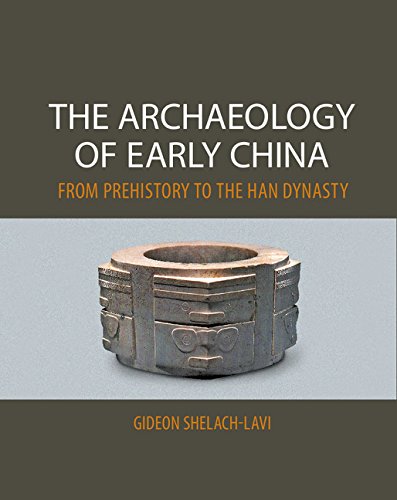
It is a real blessing to have a thorough, up-to-date, comprehensive introduction to China's archaeology (up through Han). This book will be perfect for class use. It is also a fine book to have as a reference. Anyone following the archaeology of China will be familiar with the name Gideon Shelach, and aware of his careful and thorough approach.The book is very careful about drawing conclusions or coming down on one side of a controversy, as is appropriate for an introductory work. The book has a variety of fine illustrations, and no more than the necessary amount of schematic diagramming of pots and stone tools. The only problem is that some of the maps were not well handled by Cambridge University Press (shame). Maps of temperature on pp. 14-15 show BOTH hotter and colder areas in darker and darker shades of gray--apparently the originals were in color. A map on p. 43 promises "location of sites east of [Movius' line] where hand axes are found" but does not in fact show them. I hope these maps will be corrected in future printings.That should not detract from the book, which is pretty much a "must read" for anyone interested in China's distant past.
M**Z
Archaeology in the age of nationalism and ideology
The author's descriptions and depictions (with many excellent photos, graphics, and maps) and his interpretation and contextualisation of the archaeological finds are excellent.Now, this book is very largely not about the archaeology of early China, but about that of a certain part of East Asia. Most historians begin the history of "China proper" with the Qin Dynasty in 221 BCE. The title misled me into presuming that it would mostly cover the early imperial period, perhaps with some or its Zhou precursors. Instead, the book starts with the neolithic. Now, I'm still glad to have bought the book, as it is a great read. But it is not what I needed.There is more to this anachronism. It is not only the title where "China" is used anachronistically: it is everywhere in the book. The book literally starts with a map of China within its present boundaries (indeed, withinin the boundaries it claims). Archaeologists depend on governments giving them permission to dig. Perhaps the price to pay is that in the published materials, everything is ascribed to "China," as if most of this archaeology had anything to do with modern China, other than taking place on its territory. Indeed the author goes out of his way to demonstrate that it has everything to do with "China." Is it professional expediency or is it even support of nationalistic tendencies?There would be quite an outcry if say, the Federal Republic of Germany, claimed that all neolithic, bronze, iron, and early historical cultures that flourished within the boundaries of present day Germany were by virtue of that "German." Now, the FRG, thankfully, does no such thing, nor do books about the archaeology of this region (which as far as I know never consider the present-day boundaries of Germany relevant when investigating such earlier cultures).Now, someone may say: but China is not just a present day state; it is a "culture" in its own right, and an ancient one. Yes--but how ancient? That's precisely what is at stake here, is it not. The most plausible answer is: not anywhere near as ancient as you might thing, or as this book might make you think.In the detail of his text, the author is quite critical of retroactively anachronistically ascribing things to earlier times. Unfortunately, he has no difficulty doing the opposite, which is just as little called for. One wants to give him the benefit of the doubt, but his affiliation with a university notorious to abusing archaeology to invent a past that did not exist makes one extra cautions, perhaps unfairly, but there it is.Archaeology anywhere has to move being instrumentalist by contemporary politics and ideology. Otherwise it is not archaeology--it is politics and ideology.There is another issue with focusing on "The Archaeology of Early East Asia within the Boundaries Claimed by the Present PRC" (which would be an appropriate title for the book): it largely ignores the things going on outside of these arbitrary (for the period covered) boundaries. Most notably, the first historical dynasty, the Late Chang, along with the Yellow River basin cultures among which it arose, are probably very closely associated with the cultures of the Eastern Eurasian Steppe arc, including those outside of modern China's boundaries. You would scarcely know it from reading this book. And throughout its pre-history and early history, the part of East Asia covered here, most notably the Yellow River basin, was quite open to foreign, largely northwestern, influences in terms of ideas and techniques, many of which it adopted and which became foundational for the Sinitic and subsequently Chinese culture. The author does not deny these influences, but downplays them in favour of inter-regional influences within the region covered. Which leads to the (surely false) impression that what later became "Chinese culture" was largely an indigenous and isolated development. More plausibly, it was not; but it takes a lot of effort to peel this particular onion to get to that insight.Had the author not framed everything under the rubric of "China" but instead taken the cultures as starting point as the archaeological evidence presents them, at a time when there were no such rubric and its modern boundaries, a whole different overarching picture might have emerged. The author's choice to proceed bottom up, site by site, has its merits. But one still requires an overarching view, a principle that illuminates how it all hangs together (or not). The rubric "China" is utterly unhelpful as such a principle. It's a poor choice, whether or not the choice is political-ideological.
A**R
About the problems in the kindle version: All pictures ...
About the problems in the kindle version: All pictures are grey, so it is difficult to read. And it is slow at reading a book of such size. Also, search is not implemented at the moment. Wonder if an upgraded version will be ready soon, or I should return to a paper edition?
Trustpilot
2 weeks ago
3 days ago