
DOWNLOAD THE APP


Customer Services
Copyright © 2025 Desertcart Holdings Limited
DOWNLOAD THE APP
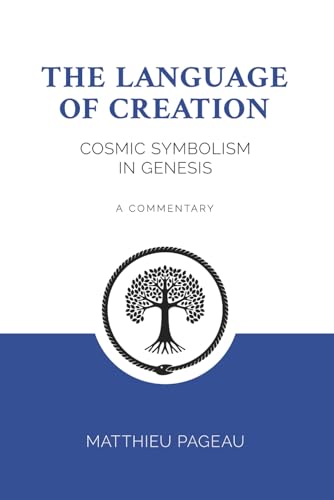

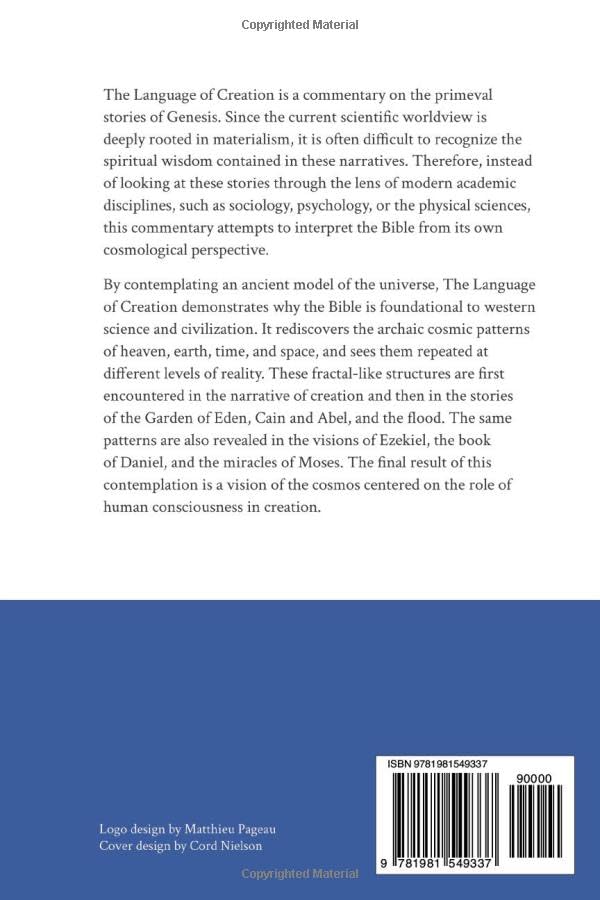
📖 Decode the cosmos through Genesis — where symbolism meets revelation!
The Language of Creation: Cosmic Symbolism in Genesis is a paperback commentary exploring the symbolic unity of meaning and fact in biblical texts, especially Genesis. Written in English and published by CreateSpace Independent Publishing Platform, it challenges conventional biblical interpretation by integrating ancient mindsets and modern discoveries. Highly rated by over 577 readers, it offers a unique lens for those seeking deeper theological and philosophical insights.
| Best Sellers Rank | #249,896 in Books ( See Top 100 in Books ) #333 in Judaism #3,510 in Christian Books & Bibles #21,869 in Higher & Continuing Education Textbooks |
| Customer reviews | 4.7 4.7 out of 5 stars (577) |
| Dimensions | 15.24 x 2.03 x 22.86 cm |
| Edition | 1st |
| ISBN-10 | 1981549331 |
| ISBN-13 | 978-1981549337 |
| Item weight | 522 g |
| Language | English |
| Print length | 354 pages |
| Publisher | CreateSpace Independent Publishing Platform |
G**R
Excellent
A**R
I recently began feeling a major pull to break away from the influence of Enlightenment rationalism and into the ancient mindset when approaching the Bible, but did not know where to begin. Authors and speakers like Dr. Michael Heiser and Jonathan Pageau played a part in solidifying that, but I still didn't know where to begin to better think on those terms for myself. I watched Jonathan and Matthieu's discussion about symbolism and thought this book sounded like what I was looking for. Most of the time when people tell you about the symbolic meaning of the Bible, they are implying that the descriptions are merely figurative, mythologized renderings of a (possibly) historical event. Well, every year new discoveries force many of them to "eat their words" ;). While laying the groundwork for a kind universal hermeneutics of symbolism, the author is careful to remind readers that "symbolic" does not mean fictional, but rather it refers to the unity of meaning and fact across multiple scales of reality. An atheist reader might continue believing that the Bible is mythology having read this book, but I suspect that they will recognize that it certainly is not merely that. As a Christian, I've found that the ideas presented in this book have added layers of depth to the theology and narratives of the Bible, and even given me new lenses to examine the world itself. There is no explicit mention of the Gospel or Christ, but there are clues along the way as to how to understand Christ in relation to this symbolic view. The first 1/3 of the book to me made it worth buying. The space/time dichotomy is certainly interesting, but it didn't resonate as much with me until it started to all come together near the end. - This is not what I would normally call a commentary in the sense that it doesn't go along with the text of Genesis. The references span the Tanakh (OT). Because of this, I feel like some Biblical literacy is highly beneficial if not necessary to get the most out of this book. - The lack of citations can be off-putting, but would probably only serve to clutter the text. The author instead appeals to observable reality and the use of biblical examples to validate his claims. - Many times, I found myself questioning something, only to have it explained paragraphs later as if this was done intentionally. If you read this with an open mind and work under the assumption that the author's interpretations are valid, it goes a lot smoother. Still, certain things are just said as if they are self evident when they aren't, or proven when they haven't been demonstrated.
S**N
Pageau beschreibt in "Language of Creation" den traditionellen, spirituellen Blick auf die Welt und die Bibel im Gegensatz zur modernen, materiellen Sichtweise. Er zeigt ein Muster auf, das der spirituellen Sichtweise einen Rahmen gibt, sowohl in der Bibel als auch in der Realität. Wesentlicher Bestandteil des Musters ist die Verbindung zwischen Himmel und Erde. Himmel steht hierbei für Ideen, Ideale, Werte, Sinn etc., Erde für physisches Material. Eine gelungene Verbindung von Himmel und Erde nennt er Raum, z.B. symbolisiert durch den Baum, ein Verlust dieser Verbindung nennt er Zeit, z.B. symbolisiert durch die Flut. Wobei Raum nicht durchgängig positiv und Zeit nicht durchgängig negativ ist, z.B. ist auch der Sabbath ein leicht nachvollziehbarer Vertreter der Zeit. Pageau beschreibt ausführlich und anhand vieler Beispiele aus der Bibel das Zusammenspiel von Himmel, Erde, Zeit und Raum. Das Buch wird wohl nicht auf Deutsch erscheinen, die englische Sprache ist hier meiner Ansicht nach aber kein Hemmnis. Wer sich für die Bibel, das Christentum, Muster und Symbolik interessiert und einen frischen Blick sucht, dem sei dieses Buch wärmstens empfohlen. Für mich persönlich ein Favorit, ich hoffe auf mehr Veröffentlichungen von Matthieu Pageau.
W**N
This book has been an invaluable resource for my Bible study group's exploration of Genesis. The author's use of simple yet effective graphics has transformed complex biblical concepts into easily understandable visual representations. I found myself gaining a deeper appreciation for the biblical narrative, thanks to the author's insightful commentary and engaging illustrations. The book has inspired a new perspective on the Genesis account, making it more relevant and meaningful to my faith. I highly recommend this book to anyone seeking a fresh and engaging approach to studying the Bible. It's a must-have for Bible study groups and individuals alike.
M**W
An alternative way of viewing the world? What’s that? I felt like a fish swimming in water when I encountered Jonathan Pageau’s Symbolic World. This symbolic world view makes so much sense but is tricky to understand. Excellent book to guide us through.
Trustpilot
2 months ago
3 days ago