

Desert Online General Trading LLC
Dubai, United Arab Emirates
Desert Online General Trading LLC
Dubai, United Arab Emirates
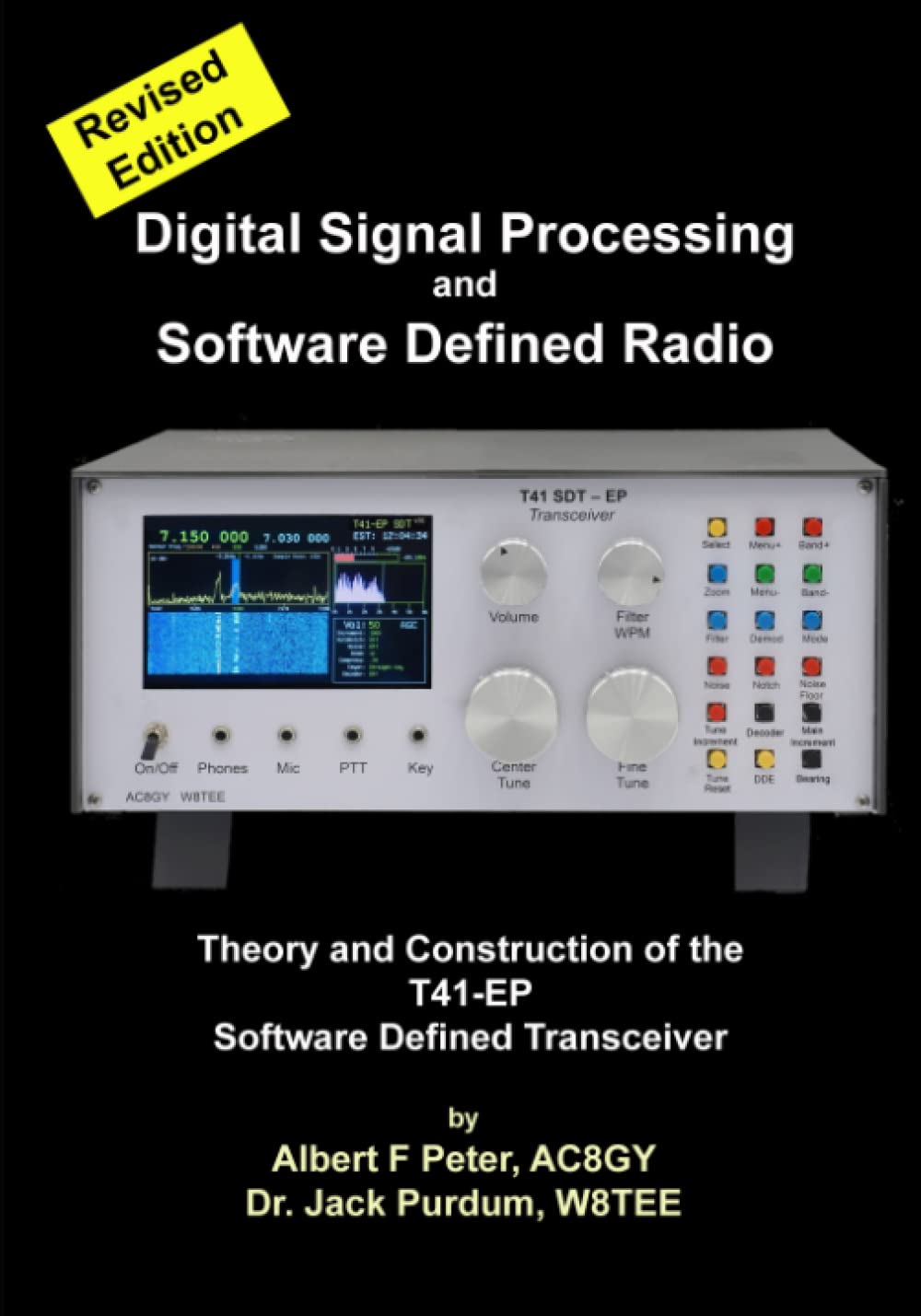

Full description not available
M**.
Impressions from a radio operator
I have been a licensed ham radio operator since `1977. In those days radios were mostly constructed with vacuum tubes. Learning about the circuits was not a difficult task. Although I have built some radio kits, I consider myself an appliance operator.My professional career was in information technology. I programmed mostly IBM computers ranging from large mainframes to PCs.In 2015 I began to merge my passion for software with my radio hobby. First modifying code for my Ten Tec Patriot and later learning how to operate a software defined radio using an ANAN-10e. It was a natural fit for me.I attempted to learn more about the design of SDRs by searching the internet for papers on the components such as FPGAs (Field Programmable Gate Arrays). As most of the papers I found discussed the engineering aspects I found the information too difficult to understand.Although the T41 does not use the same boards found in high priced SDRs like a Flex Signature Series, I think the concepts presented do shed a bright light on how software is used to process the signals as digital information via Digital Signal Processing and Fast Fourier Transforms. It certainly was meaningful to me as I examined the code that runs the T41.Building a T41 is certainly beyond my skill set. That said, I monitor the messages for the SCHR group. I look forward to reading about their journey as they build a T41 and start to experiment and make improvements to both the hardware and software.I noticed that the spine of the book bears Albert Peters name. Perhaps the principle text was created by Al. At times it is easy to tell when Al is referring to thing like Jack’s Dohickey or a reference to Al’s algorithm. Other times it seems like a third party observer is providing the narrative. The result is a demonstration of a true collaboration of a team effort. The book is light where it needs to be light. And it is heavy but clearly understood where it needs to be heavy. I certainly did enjoy reading the book and I hope others will too.
S**H
Great info.
A lot of very good information. Not for someone with no electronics experience.
J**B
Ignore bad reviews - it is fantastic
What Jack and Al have done in in this book and more importantly in this "experimenter's" guide to building a very cool software defined transceiver is game changing. They have laid the groundwork for what will become and is becoming one of the best homebrew transceivers an experienced ham can build. It is, as they point out, an ongoing work in progress - both the book and the build. There is a very active groups.io where a large number of individuals including Jack and Al are pushing this build to the next level. Yes there will be issues - that is why it is an "experimenter's" build platform. Jack and Al have been fantastic in constantly updating the book and re-releasing it and being very active in helping folks build and enhance this transceiver. Hats off to them for taking so much of their time and sharing so much of their experience with the rest of us. K5KKB
L**L
Great book
I bought the book and read it cover to cover. Jack and Al explain their Software Defined Transceiver (SDT) in terms that most hams can understand. I am no engineer, but using the book, I was able to gather the parts, buy the PC boards and build a working transceiver! I now have a MUCH better understanding of SDR (SDT...). As an old PL/I, Fortran and COBOL programmer, my understanding of C and its derivatives is very low. Jack provides insight into why he codes things the way he does. This has expanded my thought process considerably as I write my own Arduino/Teensy code.The early editions of this book had some typos, but despite negative reviews for this, I still found the book completely usable. Grammar errors (many obviously the result of a spell-checker), did not detract from the technical aspects nor from the readability. The few technical typos were easy to spot and did not lead the reader astray.I highly recommend this book whether you intend to build the T41 transceiver or not.73,Len, KD0RC
C**N
Detailed Design Information of the SDR Transceiver
Details of design and development of a sophisticated SDR transceiver in an unusual form. Rarely is an amateur electronic project design described in such detail. The book gives enough detail to understand the optimization choices the authors faced as they developed and improved their SDR transceiver. The reading level is fairly high, with presentation of complex electronic circuit detail suitable for engineering level readers. This is not a Heathkit step by step assembly guide, nor is it a textbook on generic RF transceiver design. The book is a guide to understanding the modular T41 SDR QRP transceiver in parallel with your construction of the various sections of the radio.
N**F
Groundbreaking But A Bit Slapdash
I bought this book directly from the authors in May 2022. Just as in their 2020 book, "Microcontroller Projects for Amateur Radio," Jack Purdum and Al Peter are on a mission to get radio hams building homebrew electronics again. "Software Defined Radio Transceiver," or let's just call it the "T41 Book," covers the theory and construction of a full-featured five-band HF software-defined transceiver. The authors know how to navigate the modern world of electronic modules, surface-mount components and high-level, open-source microcontroller software. They try to pass their knowledge along to the reader, and mostly succeed. This is not a toy project, but a ham builder should be able to reproduce the T41-EP transceiver with patience and perseverance.Buyers should know a few things. As of the end of June 2022, the book is still riddled with annoying typos. The project very much depends on its online support group (see page 16). The software is still a work in progress. All that said, though, Purdum and Peter have once again succeeded in pushing the state of amateur radio homebrewing forward into the 21st century.
Trustpilot
2 weeks ago
1 month ago