
DOWNLOAD THE APP


Customer Services
Copyright © 2025 Desertcart Holdings Limited
DOWNLOAD THE APP
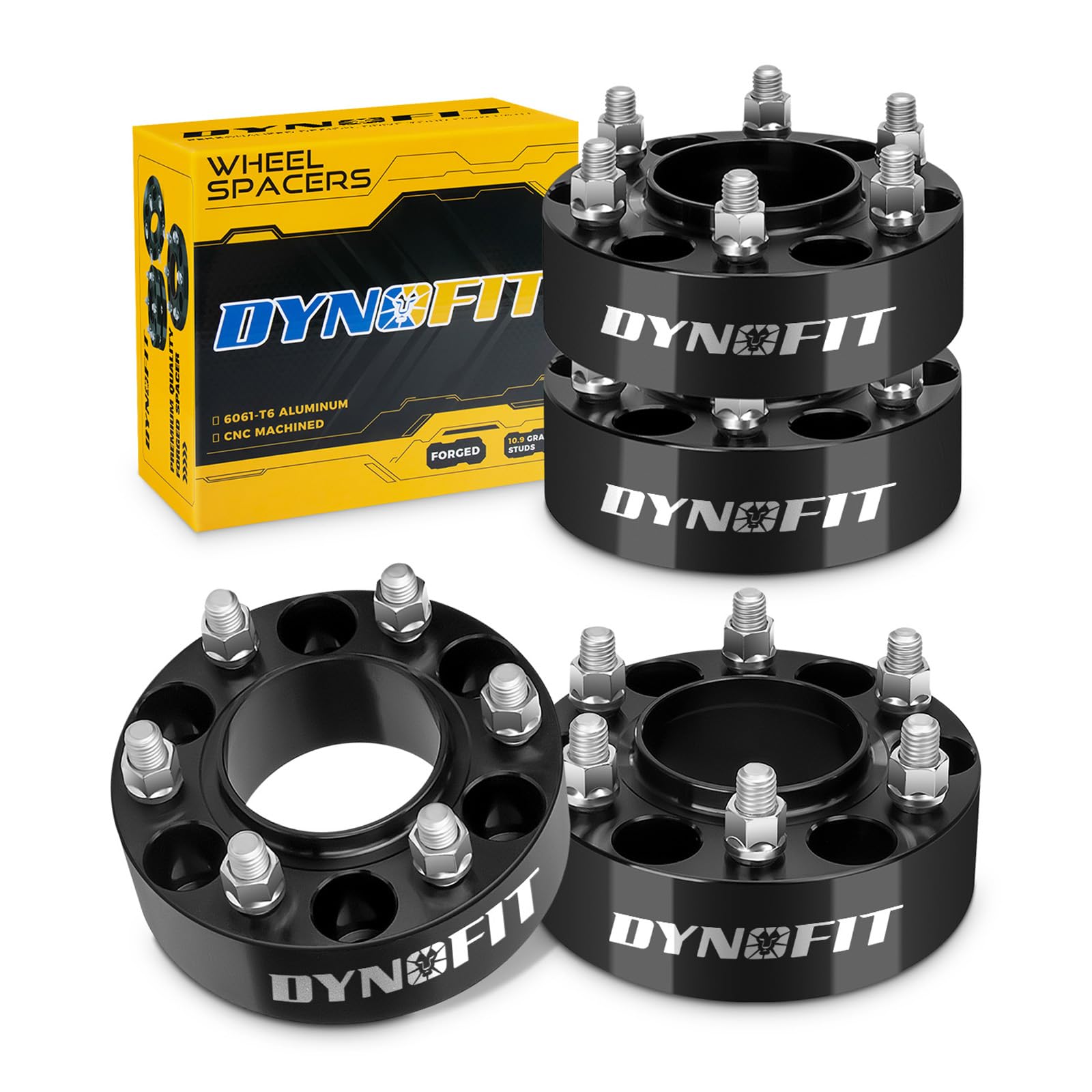
🚗 Elevate your ride with dynofit – where power meets precision.
The dynofit 6x135 Wheel Spacers are a premium set of four 2-inch thick, hub-centric spacers designed specifically for 2004-2014 Ford F150 and select Lincoln and Expedition models. Crafted from forged 6061-T6 aluminum with anodized black finish, they feature M14x2.0 Grade 10.9 studs for optimal strength and safety. These spacers enhance vehicle stance, allow for larger tire fitment, improve cornering stability, and resolve clearance issues, all while maintaining a smooth driving experience.


| ASIN | B0B79QP2VB |
| Best Sellers Rank | #20,747 in Automotive ( See Top 100 in Automotive ) #13 in Wheel Adapters & Spacers |
| Brand | dynofit |
| Customer Reviews | 4.6 4.6 out of 5 stars (388) |
| Date First Available | July 22, 2022 |
| Item Weight | 18 pounds |
| Manufacturer | dynofit |
| Manufacturer Part Number | 5007K-20 |
| Model | hubcentric wheel spacer |
| Package Dimensions | 15.71 x 8.07 x 6.97 inches |
P**G
Good Quality, Time Will Tell
These are easy to install, the directions are good, and they look great. I am surprised the torque specs for the wheel are only 85-95 foot pounds while the factory spec is 150 foot pounds.
P**H
Good Quality. Tight fitting. No problems.
So far so good. Nice and tight on the hub. Provided thread locker got it to stay torqued at 90lbs. Good looking stance now and tight highway turning keeps me planted on the road with way less body roll. Buy these quality hub centric spacers if you’re looking for what I was. I trust these to stay put.
T**S
Perfect figment
Great fit , easy to apply perfect size for my 21 STX 4x4
J**E
*The Review You're Looking For* Torque Values, Anti-Seize, Loctite and Failures
This is supposed to be the review to actually, really, answer your questions about torque on the spacer to hub, and the wheel to spacer. Explain the manufacturer's weird lower torque recommendation, should you use Anti-Seize or Loctite, and why you hear some catastrophic failure stories. First off, these are quality hub centric spacers made to tight tolerances. The studs appear to be genuine 10.9 - and the units are actually branded with KSP on the bottom. A more well known brand - so that's good news. The manufacturer gives cryptic answers about what torque (whether it's spacer to hub, wheel to spacer, 95 lbft or factory 150). More confusingly - ever review seems to recommend something different. *Torque Summary: Spacer -> Hub (dry threads, 95-105 lbft / loctite 85-95 lbft) Wheel -> Spacer (dry threads only 130-150 lbft) After 50-100 miles remove the wheel and check torque on the wheel - then remove and check torque on the space. On this first retorque you may get 5-10° of movement which is normal. Subsequent re-torques should be done every 1-5,000 miles. *Why those Torque Values: Note - on install remember that loctite (and especially Anti-Seize) act as lubricants that lower torque to achieve the same clamping load. Wheel Spacer -> Hub The manufacturer recommends ~95 lbft because that is roughly how much torque (dry threads, with the 60° conical seat) you can apply to 6061-T6 aluminum before embedment and some local yielding occurs. This is also why tightening beyond ~100 lbft (say to 150 lbft) may actually cause the nuts to move *more*, not less, at subsequent re-torques. This isn't due to bad quality or material - it's normal. When using loctite, that lowers the torque required slightly, likely why they give you a range of 85-95 lbft. Your Wheel -> Spacer When bolting the wheel to the spacer - this local yielding effect is minimized by the large area the wheel contacts on the spacer, and the area that the stud meshes into the spacer. Here, you can use the OEM 150 lbft. However, some minor local embedment may occur where the stud head sits into the spacer, so 130-140 is a slightly more conservative option if you feel the need. **DO NOT use Anti-Seize or Loctite here** *Why you see catastrophic failure stories / what happens when you torque incorrectly: These are almost always from cheap, non-forged, non-hub centric, or (most often) >misuse< on install. Most often, people over torque these. A lot of the times, people get away with it - but it's not proper - and many don't get away with it. Due to the local yielding (on spacer -> hub), OEM 150 lbft will cause deformation. This, especially, when coupled with anti-seize or Loctite on the threads, can cause local stress cracks that may cause major cracking. Stick to ~100 lbft dry or ~90 lbft with loctite. Never use Anti-Seize on this part. If you do this, and check your torque every so often it will be fine. Studs on the spacer snapping is another issue you may see. The studs on the spacer or nearly, or as strong, as the factory studs. They can handle 150 lbft OEM torque no problem - as *long as the threads are dry*. On my experience, studs snapping on these spacers happens because people use Anti-Seize, or even loctite (which acts as a lubricant) and still torque to 150 lbft. This get dangerously close to yeidling the stud - and after a harsh on road impact - can cause snapping. Stick to 130-150 lbft DRY and check intermittently. You should be fine. *Conclusion: When used properly - these are clamped friction bound joints. They are very strong, and people regularly use them on rock crawlers etc. If you install the properly, and intermittently check torque - you can rest easier. I personally torque torque the spacer to 100 lbft dry, and the wheel to 140 lbft dry. After my first retorque on the spacer, I don't get any movement. They have seen 1200 mile road trips - and I bought specifically for burning trails and mudding. They've been excellent, no issues. The info online - even form the manufacturer is confusing and unhelpful imo.
E**L
Excelente
Excelente
E**S
Work great
Nice spacers, good quality, easy installation
E**O
I love the way it looks
M**.
Llego en perfecto estado justo como lo esperaba
أ**ي
كانت سهلة التركيب ومناسبة جدا لسيارتي f150 xlt 2012
O**R
C**N
They are what they say there are. Good communication with seller. Fast responses.
A**R
Fit well
T**W
When I had my wheels torqued the stud twisted off. These are not safe...DO NOT BUY!!!
Trustpilot
2 weeks ago
1 week ago