Desert Online General Trading LLC
Dubai, United Arab Emirates
Desert Online General Trading LLC
Dubai, United Arab Emirates

Full description not available
R**R
One of the most peculiar and memorable books I've ever read.
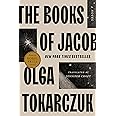
One of the most peculiar and memorable books I've ever read. Also one of the most difficult to read.It is a long, amazing trip to eastern Europe in the 18th century, the tale of Jacob Frank, a Jewish messiah, who created a new religion and told his follows that they were obligated to break as many moral boundaries as possible. The narrator, Yente, is a dead woman and the pages are numbered backwards from 892.A sampling of my favorite passages:"There is something wonderful in being a stranger, in being foreign, something to be relished, something as alluring as sweets. It is good not to be able to understand a language, not to know the customs, to glide like a spirit among others who are distant and unrecognizable. Then a particular kind of wisdom awakens -- an ability to surmise, to grasp the things that aren't obvious. Cleverness and acumen come about. A person who is a stranger gains a point of view, becomes, whether he likes it or not, a particular type of sage. Who was it who convinced us that being comfortable and familiar was so great.? Only foreigners can truly understand the way things work." p. 374"But then I thought that one would be a fool to expect people to remain as they once were, and that it is a kind of overpridefulness in us to treat ourselves as constant wholes, as if we were always the same person, for we are not." p. 200"For when the spirit enters into a person, it happens as if by violence, as if the air were to penetrate the hardest stone." p. 198"Over time, moments occur that are very similar to one another. The threads of time have their knots and tangles, and every so often there is a symmetry, every once in a while something repeats, as if refrains and motifs were controlling them, a troubling thing to notice. Such order tends to overburden the mind, which cannot know how to respond. Chaos has always seemed more familiar and safe, like the disarray in your own drawer." p. 163"Either the real or the intelligible universe has infinite points of view from which it can be represented, and the possible systems of human knowledge are as numerous as those points of view." p. 143 [quote from Diderot]"The Ascherbachs don't care about being paid from their writing, of course -- they are doing perfectly well as it is. It is more a need, a kind of calling -- to polish words so that it will be possible to see through them clearly." p. 141"The truth is like a gnarled tree, made up of many layers that are twisted all around each other, some layers holding others inside them, and sometimes being held. The truth is something that can be expressed in many tales, for it is like that garden the sages entered, in which each of them saw something else." p. 79"In this sense, death doesn't really exist, thinks Ascher -- no one has ever described the experience. It's always someone else's death, a stranger's. There is no sense in being scared of it, since what we would be scared of it ... is something other than what it really is. We are afraid of an imagined death (or Death), a thing that is a product of our mind, a tangle of thoughts, tales, rituals. It is the contractual sadness, the agreed upon caesura, that introduces order into human lives." p. 68"There is no final exhalation, Ascher thinks with mounting rage, no soul slips out the body. Quite the contrary, the body sticks the soul inside it, so it can carry it into the grave. he has seen this so many times, but only now has he fully comprehended it. Just like that. There is no final exhalation. There is no soul." . p. 66"Yeruchim, when he succeeded at it, would giggle, and it would seem to me that was exactly how God had giggled when he had created us all. ... it appealed to me to travel back, in memory, because the past remained alive for me, while the present was barely breathing, and the future lay before me like a cold corpse." p. 51"The truth of the world is not matter, but the vibration of the sparks of light, that constant flickering that is located in every last thing." p. 48"The only thing Yante can think of that is like this is tracks in the snow -- since the dead lose their ability to read, one of death's most unfortunate consequences ... There can be no doubt that the world is made of darkness. Now we find ourselves on the side of darkness." p. 27 (the last page).
L**G
Incredibly rich... But overlong
This is a book which requires patience. It's fascinating and amazingly well researched. As a descendent of Ashkenazi Jews of the area and era I identified with the characters as they often matched the brief descriptions of shtetl life I was able to glean from my grandparents. But the author attempted too much, in my opinion, and in the end the attempts to tie up all loose ends seemed forced. Overall an excellent read but would benefit from some editing.
P**T
Fascinating
Fascinating, great writing, worth its length. Got a little overwhelmed following all names but then I quit worrying about it and feel I missed little, even when the character names got somewhat confusing. At another point it began to feel too long - but that lasted for only at most a short chapter and am so glad I didn't give up because it remained fascinating through to the end. And such a run through a part of history and culture I knew very little about. Used google a lot as I read and that made the book all the more fascinating.
A**S
At the Crux of the Modern World
Olga Tokarczuk’s magnum opus, The Books of Jacob, is indisputably a masterpiece of historical fiction. But it’s more than that: it suggests answers to modernity’s most pressing questions; answers that, while long accepted in parts of the world, are unsettling and provocative in her native Poland. Hence the heated controversy around its publication and her subsequent Nobel Prize.In relatively terse and simple prose, Tokarczuk tells the story of a Jewish sect who ran afoul of Catholic and Rabbinic authorities in seventeenth century Poland. The characters are fully enfleshed: she uses her training as a Jungian psychologist to make the characters leap out of the book and into the reader’s world. The surrounding cast of lords and ladies, innkeepers and madams and bishops and priests all have a similar believability. The trauma experienced by the sect as it is shunned by rabbinically led communities while also having to shed its Jewish identity is expressed viscerally.Moreover, the depth of historical research is beyond impressive. One follows the sect from village life in Poland, to the frontiers of the Ottoman Empire to a denouement in Enlightened Austria. Throughout this narrative, Tokarczuk characterizes and comments on the culture and peoples they pass among.But there’s more to the book than simply historical fiction. As a result of the Holocaust, modern Poland is a country made up of one ethnic group and religion. Tokarczuk, on the other hand, crafts a Poland where Orthodox, Jews and Catholics all mingle, where Ruthenians, Poles and Armenians all brush shoulders…in short she crafts an image of a multicultural society.Beyond ethnic differences, Tokarczuk provides her take on Jungian thought by opining that a major root of human suffering is religious dogma, law and hierarchies. For Tokarczuk, we all have a certain light with which to see the world. Only by sharing this light can we penetrate the darkness. Only by writing do we bring about a shared world.Moreover, by bringing up events like the libel that Jews murdered Christian children for their blood and the various hypocrisies of the Catholic hierarchy, Tokarczuk really means to plunge a knife into the heart of Polish ethnocentric nationalism.So, as a work of fiction it’s worthy of the attention it received by the Nobel committee; as for its themes, each reader can decide for themselves whether overturning religious doctrines and authorities would really help or harm humanity.
J**I
A wonderful book betrayed by its editors
At nearly 1000 pages this is a long long read. There are hundreds of pages not necessary to the story. The last 200 pages seem like an afterthought. The writing is beautiful. But there are so many characters and places, all with unpronounceable names, that change multiple times across the scope of the book, that it becomes difficult to keep track of the characters and their significance. Then there are open questions. What exactly was Jacob? Was he a prophet or just a strangely obsessed man? What difference did his life make if everything dissolves in the end?
Trustpilot
2 weeks ago
4 days ago