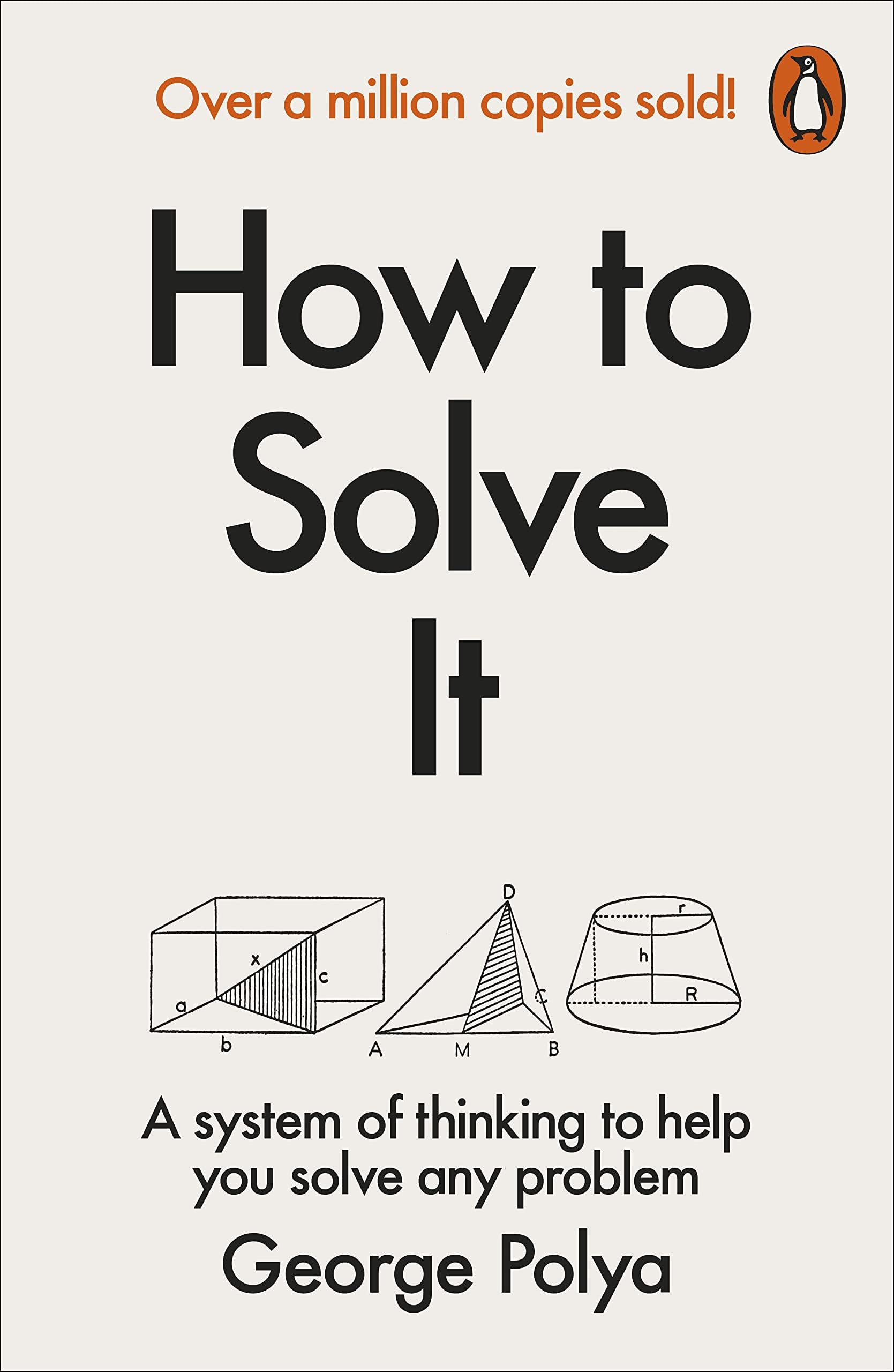
How to Solve It: A New Aspect of Mathematical Method
Desertcart purchases this item on your behalf and handles shipping, customs, and support to Croatia.
Description
🧩 Crack the code of every problem with the ultimate math mindset guide!
- BOOST YOUR ANALYTICAL THINKING - Learn how to dissect problems, identify weak points, and develop winning strategies that transcend math.
- ENDORSED BY MATHEMATICAL LEGENDS - Praised by experts like Marvin Minsky and Ian Stewart, this book is a must-have for serious thinkers.
- A TIMELESS CLASSIC FOR ALL LEVELS - Whether you’re a student or a seasoned mathematician, this bestseller sharpens your problem-solving toolkit.
- MASTER THE ART OF PROBLEM SOLVING - Unlock George Pólya’s proven strategies to tackle any mathematical challenge with confidence.
- JOIN A GLOBAL COMMUNITY OF THINKERS - With over 1,500 reviews and counting, be part of the worldwide movement inspired by Pólya’s genius.
How to Solve It by George Pólya is a perennial bestseller ranked top 10 in Mathematical Games, boasting 1,539 reviews with a 4.4-star average. This classic guide offers timeless, expert-endorsed strategies to enhance problem-solving skills, making it essential for professionals and math enthusiasts aiming to think clearer and solve smarter.
Specifications
| Asin | 0140124993 |
| Dimensions | 12.9 x 1.6 x 19.8 cm |
| Edition | 1st |
| Isbn 10 | 9780140124996 |
| Isbn 13 | 978-0140124996 |
| Item Weight | 204 g |
| Language | English |
| Part Of Series | Princeton Science Library |
| Print Length | 272 pages |
| Publication Date | 26 April 1990 |
| Publisher | Penguin |
Reviews
User
How to solve it ?
I thought I would buy this book after seeing it reviewed on a Japanese mathmatics program on TV . I found the contents difficult to read not being a higher maths candidate myself. How ever after trying to digest the words of wisdom in the theory of solving problems I had to admit it is only suitable for those amongst us who have a higher maths certificae than myself.very much higher ! The authur G.Polya was an aclaimed world wide mathematician, so if you are in his league then the book is worth reading ..TR
User
Great Book for any level of mathematician
Very interesting read and will be rereading in future to remind myself of its great ideas.
User
A thoughtful discussion of fruitful questions to ask yourself when you get stuck
This is a very good book that takes a lot of time to digest. So, get it well before your exam or you start your job as a trainee mathematical modeller! What I mean by that is, I read it, cover to cover, then returned to my university studies with renewed excitement and found I still got stuck. Par for the course in mathematics, but disappointing nonetheless. However, once I had solved the problem (or given up and checked the solution), then reflected on why I got stuck, a heuristic from this book often jumped out at me. Ah... if only I'd thought to try this it would've made the way forward so obvious!And that is essentially what the book is. You will not get a list of algorithms to take the creativity and hard work out of mathematical problem solving (frankly, that'd no more be a good thing than taking the creativity and hard work out of sport). What you will get is a discussion of thought processes that professional mathematicians use, probably unconsciously at that stage of education, that may help you make headway on your problem. Essentially, 'What are fruitful questions to ask when I don't know how to proceed or even begin?' (Hint: don't just sit there and stare at it waiting for the muse to strike you.) In fact, you probably use some of these already but don't even realise you're using the same strategy over and over again. In this way, Polya has done what mathematicians do: he has abstracted, generalised and systematised a hitherto hodgepodge of problem-solving recipes used implicitly in particular situations.A simple example for when you get stuck: 'Can you rewrite the equation?' I cannot count how many times I have fallen into this trap, realising after I've given up on a problem that the way to proceed would've jumped out at me had I only thought to rewrite it in a different form. On one level, it might simply be that you, personally, are really quite uncomfortable with a particular form of notation. Rewriting things might well put you at psychological ease with more familiar forms, or forms you're much better practised at manipulating. Hate Leibniz notation for your calculus? Why not rewrite it as Newtonian to solve your problem, then translate back into Leibniz? This strategy, in fact, is what we do all the time - when you learn trig identities or to move between forms of vectors, say, you are implicitly learning the strategy: 'Rewrite the equation to make it easier to deal with.'The other reason might simply be that by rewriting it, the solution jumps out at you. This is what happens whenever you multiply out, factor, substitute into equations etc. Just because your question doesn't specify you need to do something, doesn't mean you aren't allowed to try it! But it has to occur to you first to rewrite your problem into an equivalent form, in order for the light at the end of the tunnel to reach you. And really this is something you do already: whenever you look up a word in a dictionary, you're essentially seeing the term which you don't understand rewritten as something you do understand. Then you can proceed with your paragraph, just like you can then proceed with your mathematical problem.
User
Very useful for the avid problem solver!
This book teaches you to dissociate yourself from the problem posed and ask yourself logical questions to decompose the problem before forming a plan.
User
Good book
Haven’t read it all yet. Good so far and fast delivery was much appreciated.
User
Enlightening
Enlightening ones mathematical mind and thinking out side of all boxes.
User
Good book, but bad customer experience
I have heard good things about this book, the content is good, now the book I got has it's cover all damaged and not clean
User
Good book for any teacher.
Great read if looking to improve how you teach people and try to engage them by asking the correct questions. Book it self can act as a teacher to one self.
User
Kağıdı kalitesiz
Kitap biraz hırpalanmış geldi bir de kağıt kalitesi biraz tırt yani yanlışlıkla bişey dökerseniz sıkıntı
User
数学教師や学生には参考になるのでは、、
数学の問題を解く方法が、学生を指導する、という視点で体系的に述べられています。 解答を導き出すための学生への質問集も用意されています。 考え方にびっくりするほどの斬新さは感じられませんが、数学教師や数学を志す人には役立つと思います。 では数学以外の一般的問題解決やプロジェクトなどの問題分析に役立つかというと、プロセスマネジメントが発達した現代ではそこまでの応用力を求めるのは無理かな、と感じました。 文章は簡潔で英語は読みやすいです。 今まで馴染みのなかった数学英語に接することも出来ました。また、錆付いた数学知識を(ある程度)思い出すきっかけになったと思います。 ガリレオ時代のフランスの学者 Descartes,Reneが引用されていたりもします。
User
Muy bueno
Este libro es un pequeño tratado de heurística. Describe generalmente el proceso seguido para resolver problemas, aplicable a cualquier tipo de problemas, particularmente matemáticos (en los cuales se centra el autor). El libro esta escrito por un importante matemático de origen húngaro, y aunque ya han pasado unos 40 años de su primera impresión, su contenido no está obsoleto ni ha perdido vigencia. Resultará de interés a cualquier estudiante de ciencias (naturales,pricipalmente) o ,sobre todo, de matemáticas (entre otras cosas trata la intuición en matemáticas y la importancia de las demostraciones formales). La edición es buena y relativamente robusta.
User
Good Book.
This is an interesting read
User
A book for lifetime
This book is life changer . Even If you are an adult but still love to understand the mathametical concept buy it . A great mental exercise into problem solving
Common Questions
Trustpilot