Desert Online General Trading LLC
Dubai, United Arab Emirates
Desert Online General Trading LLC
Dubai, United Arab Emirates


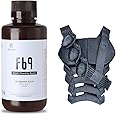
🖤 Flex your creativity with RESIONE F69 — where toughness meets rubber-like softness!
RESIONE F69 Flexible Black Resin is a 500g TPU-like 3D printing resin designed for 405nm UV curing. It boasts 255% elongation at break and 47.2KN/m tear strength, delivering durable, rubber-soft prints compatible with most LCD, MSLA, and DLP printers. Ideal for flexible, impact-resistant prototypes and customizable toughness blends.
| Manufacturer | RESIONE |
| Brand | RI RESIONE |
| Model number | F69-500g |
| Package Dimensions | 20.09 x 8.41 x 8.2 cm; 500 g |
| Color | Black |
| Material Type | Resin |
| Number of Items | 50 |
| Size | 500g |
| Manufacturer Part Number | flexible |
| Item Weight | 500 g |
C**V
Es muy difícil de usarlo
Es muy difícil poner el tiempo de exposición y de 10 piezas solo 2 salen bien debería haber una ayuda para usuarios
E**E
With the right (extreme) settings, it works.
This resin can produce good results if you use the right settings, but the right settings aren't obvious.First, it is very opaque, so the plate has to be extremely level for the first few layers to attach properly.Second, it is *extremely* thick. This means that if you are printing any flat surface more than a few cm on each side, the resin won't be able to flow in and out quickly enough. This causes problems both on lift and return of the plate.On lift, it generates a suction force that can cause the print to detach from the plate, from supports or even from itself. The solution to this is to lower the raise speed to *extremely* low. I'm using 10mm/sec for the first four mm, 70mm/sec for the rest of the lift.A similar problem happens when the plate is going down: any relatively large surface will need to evacuate the resin as it goes down, and that won't be possible if the plate is moving too fast. As a result, at best the layers will be thicker than they should, and at worst they will peel off since they re too thick for the light to reach the already printed parts though the dark, opaque resin. For large flat surfaces I was getting at 0.05mm setting layers that were four times as thick! There I also use 10mm/second on the downward move for the last 4 mm, 50mm/second for the rest, plus I wait one extra second at the end of the move before lighting the LCD up.As for other settings, if I print at 0.05mm layers, they come out fine but for large surfaces they come out a bit thicker than desired even at those speeds, and at 0.1mm the thickness is as expected but I have to use an exposure time of 8 seconds for each layer, and 50 seconds for the base.So for large flat surfaces that require such values the printing process can be SLOOOW. Printing a patterned slate 2mm thick took 30 minutes! For smaller surfaces and shells I was able to do with faster (but still low) move speeds, but it's still much slower than printing with normal resins.As for the resulting objects, they are fantastic. I was able to print rubbery patterned surfaces that can be wrapped around contoured objects, model vehicle tires and other flexible items, with great accuracy and detail.Just be prepared to waste your first $57 on trials until you figure out the right settings. I am happy with the product, but I am dinging one star because the company should provide detailed guidance on the right settings for different scenarios given how out of the ordinary this resin parameters are.
R**N
Product was leaking.
Product works great but the cap was opened when it arrived. They need to spend a couple dollars to seal the container like their competitors. Considering the nature of the hobby and mess, I may have to find a new supplier. It's just a safety thing.
D**N
There is a learning curve here.
Fully agree with E. Saggese's excellent review but I will add my own thoughts.I purchased this material to make evaluation models, not for any production purpose. For flexible models I now believe a better approach is to make a mold on the FDM printer (or resin printer), and then use one of the pourable/castable resins from places like smooth-on.com This provides you best set of options for durometer and material.F69 wants to stick to the FEP film on each exposure. You can actually here suction and popping away when the plate pulls away on the retraction.I've downloaded RESIONE's settings for Chitubox, including the support profile. But still ran into problems. I suspect I will be implementing the retract speeds that Saggassese has suggested.RESIONE suggests 80-90% support density. They mean it. This is sad because it means that much of the resin will be consumed to make supports. I had failed prints with support density at 50 and 60%. What happens is the supports will print fine but as soon as the cross sectional area of the model develops it will adhere to the FEP and the supports will break away from it. So for this reason you need a lot of supports.As mentioned by others, this stuff is thick and viscous. Pouring it through a filter back into the bottle takes an eternity.
C**Z
Works well
I use it for action figure stuff, mainly on my Elegoo Mars 3 pro, and sonic mini 8k. The default lychee slicer settings worked for both, you need a lot of supports.
Trustpilot
2 days ago
1 month ago