Desert Online General Trading LLC
Dubai, United Arab Emirates
Desert Online General Trading LLC
Dubai, United Arab Emirates

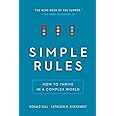
Simple Rules: How to Thrive in a Complex World
D**O
Erudite, practical, and novel – a highly recommended read
In Simple Rules, Sull and Eisenhardt provide a new framework for managing the complex systems that permeate human society – e.g. marketplaces, electorates, justice systems. These systems are too complex to model deterministically, but basic threads of causality can be identified through experience, data, or experimentation (if they couldn’t, it wouldn’t be possible to manage a business better than a random decision-maker). For a given, critical decision at the core of a business’ value creation, those threads can be translated into a small set of simple rules that treat 90% of cases effectively while providing flexibility to handle the 10% outliers ad hoc. Those rules enable effective, consistent decision-making without extensive investment of time and resources on each individual decision; they are at the core of implementing strategy. If you understand and believe in strategy, then you almost certainly are using simple rules.These concepts are in truth nothing new in that, as the authors cite time and again, planners of every sort – managers, politicians, communities/guilds, natural selection – already naturally establish such rules to great success. The arguments of the book are therefore not theoretical, but thoroughly evidenced with case after case across diverse systems. In contrast to some other reviewers, I found the extensive examples to be one of the great sources of value of this text as those examples (a) show the ubiquity of these effects, (b) reveal nuances in application otherwise belied by the simple core concepts, and (c) make how to apply the principles more concrete to the reader’s own case, by analogy. The biggest contribution of this book is in my opinion therefore not to propose theory, but rather two-fold:1. To organize the principles of simple rules that have naturally emerged for almost any reader into a comprehensive framework that allows the reader to recognize when she is not using such tools and should be.2. To condense the lessons of refining and applying simple rules to help readers improve upon what they might naturally develop.In other words, this book not only organizes a theoretical framework, but is truly practical for managers to apply. I strongly recommend this book to any reader.
B**K
Fix The footnotes!
Great and entertaining content that is upset through a lack of footnotes links in the Kindle version.This tends not to go heavy on the anecdotal side but provides a good framework for identifying, analysing and formulating simple and powerful rules
W**K
A good book that could have been a great book
I’ve been a fan of simple rules for years. Sometimes we called them “simple rules” and sometimes we called them “guidelines.” Sometimes they were “rules of thumb” and at other times they were “heuristics.” But I know how powerful and useful they can be. And, several years ago, I read Kathleen Eisenhardt’s book Competing on The Edge, which I thought was remarkably insightful and helpful.Put those two things together and you can guess that I was excited about reading Simple Rules: How to Thrive in a Complex World by Kathleen Eisenhardt and Donald Sull. I found a lot to like, but I was also disappointed. This is a good book that could have been a great book.Here’s the author’s definition of simple rules.“Simple rules are shortcut strategies that save time and effort by focusing our attention and simplifying the way we process information. The rules aren’t universal – they’re tailored to the particular situation and the person using them.”That’s a good definition, and the first part of the book covers the basics of simple rules. After the introduction, there’s a chapter on why simple rules work and when you use them.You want to use simple rules for repetitive judgement calls. They should be tailored to a specific activity, especially when you must make a decision on the fly. They should be usable by a specific group of people. There are two other specific things about using simple rules that you should know.Simple rules are guidelines, not recipes. They don’t tell you what to do. Instead, they tell you how to decide what to do quickly. Simple rules are also the most powerful when they’re applied to important things. You can certainly use them for less important things, but importance and power go hand in hand.We live in a world where things seem to become more complex by the day. The temptation is to meet complexity with complexity. That’s what legislators try to do when they crank out laws that run to thousands of pages to try to deal with a complex marketplace or a complex regulatory challenge. Those thousand-page laws generate thousands of regulations. Even with all that effort and applied brainpower, I can’t think of a single situation where it’s worked.Simple rules give us a way to fight complexity with simplicity. That’s one of the big takeaways from this book.The chapter on Making Better Decisions introduces us to three kinds of rules. There are boundary rules that tell us where to do things and where not to do them. Prioritizing rules help us decide what to do first. And stopping rules help us know or decide when it’s time to quit and move on.Up to this point, Simple Rules is solid, helpful, and lean. There’s a lot of value. That changes when we move into the chapter on Doing Things Better. There, we’re introduced to two more kinds of rules: coordination rules and timing rules. I’m sure they can be helpful, but I never got the point. I could have skipped this chapter.The chapter on Where Simple Rules Come From is interesting, but not necessary. You can pick up some common-sense tips, like the fact that people are more likely to follow rules they help develop, but you might be able to skip this chapter entirely, too.I expected the chapter on strategy and simple rules to be really helpful. Several writers, such as Erika Andersen, have approached strategy with just this idea in mind. If the people on the front line don’t have simple rules to follow, they’re not likely to do what you want, especially under pressure. Alas, this is where the book starts to wander off into the weeds. We’re told “When it comes to deciding where to apply simple rules, the most obvious activity is not always the right answer.” That’s certainly true, but it would have been better if the authors had given us clear and full advice on how to decide what is the right answer.The authors talk a lot about bottlenecks. But their definitions aren’t very helpful and their examples sometimes make things worse. Not only that, in my experience at least, bottlenecks are only one of three things you want to look at if you want to make an organization more effective.I think of a bottleneck as a place where a process slows down. When you fix the bottlenecks in a process, and you speed the process up. The authors cover bottlenecks, but they ignore two other important things where simple rules can help.Leverage points are activities that have an outrageously large effect compared to the amount of input. They’re the 20 percent of the things you do that give you 80 percent of the results. Making performance on these things more efficient will have an outsized impact on organizational performance.Every industry or company has Key Success Factors, the things you must do if you want the organization to succeed. Simple rules can help you perform better on your Key Success Factors.There are also interesting and helpful things in the book that don’t move the book forward. Two examples are the interesting stories about Roald Amundsen and about Money Ball. There are lessons here, but I’m not sure how they relate to Simple Rules.Bottom LineYou’ll get good value from this book if all you read is the first few chapters. You can read the rest and draw what lessons you will, enjoy the stories that you enjoy, and think of them as a bonus.
G**Y
Simple idea to grasp but a variety of applications
Having read books such as Kahneman's 'Thinking fast and slow' and Schwartz's 'Paradox of choice' which both promote the idea of automating frequent decisions I was curious as to whether this book would add more detail to this potentially useful idea. Short answer? It did!The specialism of the authors seems to be in helping business to identify where simple rules might make their processes more effective and then creating effective ones but the book does cover personal applications of this idea too.To summarise briefly, they suggest identifying (systematically) what it is you are trying to achieve, identifying any bottlenecks that limit your progress, creating specific rules that guide future behaviour and then refining those rules as you go. This might seem like common sense and unnecessary to write a book about but the examples provided are useful to illustrate how this process can best be tackled.As a side note, the seller provided the book in a timely fashion and to the standard described.
R**E
Reglas para ser práctico
Buen libro para ser práctico en la complejidad, y lleno de ejemplos de todo tipo, tanto del mundo empresarial como de una gran variedad de áreas de estudio y vida común.
M**A
Well written and insightful
Excellent illustration of the hard work required to reach the simplicity that is necessary to consistently tackle and thrive over complexity in the long term.
K**D
Enlightening
Could have done with a few chapters less. Otherwise a great addition to traditional strategy books. What I missed in the strategy part is the acknowledgement of current success and distilling simple rules of effective practices thus far.
S**S
Transformative book for me
This is one of a transformational book for me . The concept even though simple is great if you just put it into practice even in a complex scenario. The narrative of the book very apt in terms of how exactly to use the principles in the book in a real-time scenarios. More such transformative books and one's life is sorted.
Trustpilot
5 days ago
2 days ago
1 month ago
2 months ago