Desert Online General Trading LLC
Dubai, United Arab Emirates
Desert Online General Trading LLC
Dubai, United Arab Emirates

Full description not available
M**A
A Mosaic of China
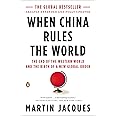
I am sure that China has all three dimensions -- China has the past, has the present and china has the future. Millions people, including Chinese themselves want to understand China and Chinese and I believe that many of them bought or will buy this influential Martin Jacques' book, because it offers views on China.Mr. Jacques began with the history, then continues with the present and finally he hinted the future. The book described important parts of Chinese history, such as connection with Japan, dealt with first connections between West and East, paid attention to Chinese ethics, including implicit one, and last but not least mentioned politics. I can underline that China is turbulent country, it means that some facts are becoming obsolete... so readers ought to accept this information (actually it is the 2nd edition, the 1st edition was published in 2009. But now--in March 2015--also this the 2nd "greatly expanded and fully updated" edition is now partially out of date).Of course, some information can be doubtful/questionable because of obsolescence, or point of view, or because of presumption (I should mention that M. Jacques--born in 1945--was editor of the Communist Party Great Britain's Journal "Marxism Today" from 1977 until its closure in 1991).Well, we never forget that it is only one view from several possible views. On the other hand I declare that this book could be very useful for sinologists, ethics, admirers of East and politics as well. Martin Jacques' "When China Rules the World" offers eloquent mosaic(s) of China.
B**N
Didn't agree with everything, but worth reading
Living in Japan, I am constantly hearing from Japanese and American news sources about the rise of China. This book caught my eye. I ripped through it in 2-3 days.The highlights for me included the chapters on China's attitudes towards non-Chinese and its own place in the world. I really get the impression that the West views the rise of China as something new while the Chinese see this as a return to their "rightful" place.Another part where the author shines is when he discusses the emergence of non-Western forms of modernity (first Japan, then China). He picks up on an idea that Huntington wrote about in "Clash of Civilizations", namely the West will have to accept that the non-Western world is fully capable of creating their versions of modernity separate and independent of the West.Personally, I am not sure if China will ever truly "rule the world". Economic bubbles always pop and their science/technology is still based on copying other people's ideas (namely Western and Japanese). Time will tell if the Chinese can also become innovators as well.Having said that, I can certainly see China remaining a pivotal economic/political power in the world. Or at least in Asia. And I can see China representing an opposite polarity of "autocratic capitalism" to the the USA's democratic capitalism.I took away one star as I saw the author's Marxism coming through in his analysis of China versus the West/US. Although much of the data provided is solid, he does seem to take a somewhat anti-American attitude. And perhaps this is just my own prejudices as an American.Overall, a great read and food for thought. Next, I want to read "Why China Will Never Rule the World" to get some balance.
F**G
China's unstoppable move to modernity as a cultural state
China's unstoppable move to modernity as a cultural stateBy Francis C W Fung (...)Updated: 2010-03-02 09:29China missed out on the 19th Century industrialization. This time she is moving towards modernity with determination as a Cultural State. Soon President Obama will go to Indonesia and Australia for state visits. He will be likely welcomed as a return of the favorite son and will be told that China's growth is good for Indonesia. In Australia he will hear that for the first time, a white Anglo-Saxon nation state's continuing growth is dependent on China.In a Feb 1, 2010 PBS Charlie Rose interview, Larry Summers, economic adviser to President Obama, offered the following summary of his view on the 21st Century. First, the most momentous event in the 21st Century is the rise of the developing world, not the current financial crises. Second, the most important thing a major nation must do is to empower the growth of the vast middle class. Third, in the 21st Century we must know how to harmonize with the developing world, most of all with China.Above vision seem in all respect a fit description of China's growing momentum as analyzed in detail by Martin Jacques's book "When China Rules the World". Contrary to the title of the book, Jacques's final conclusion is that China will not rule the world. He believes the rise of China will be the revival of the Chinese culture, and China will resume its heritage of a magnificent civilization as a Cultural State.Martin Jacques also argued strongly that modernity is not necessarily Westernization specifically in reference to China. China is so immense, following her major developed cities and regions, her rural areas still have a lot of room to grow. Jacques with in depth analysis to differentiate China from the European Political States also defined China as a Cultural State and not a Political State because of her long civilization. Of interest, Jacques pointed out that China as a Cultural State in her development will revisit her ancient cultural heritage and rediscover her cultural roots such as Confucianism and Daoism and all their teaching of Harmony. Also China in her move towards pluralism will invent her own democracy. This is supported by John and Doris Naisbitt, in their 2009 book China's Megatrends. John and Doris detailed in their book that a top down and bottom up convergence democracy is emerging in China that is holding the government accountable.China's move to modernity is unstoppable despite America's intervention with the so called Smart Diplomacy. China's growth will benefit not only her but the whole world. Further, China will not challenge America's military hard power rather in soft power because she is a cultural state. Within China as a cultural state various political systems are allowed. That was the terms on which Hong Kong returned to China as one country two systems. In the same way the mainland extends her hand to Taiwan for reconciliation.China's growth is unstoppable because the momentum she has generated within and the vast potential she has created for her continuing growth together with the world. The Western media in its eagerness to be politically correct still writes with deep rooted Cold War mentality. Is China really a communist state according to our Cold War definition? Will bring back the Cold War work to stop China growth? America took her eyes off the ball because of preoccupation with the Iraq and Afghanistan wars during the last ten years. During that time China achieved unprecedented growth in human history in scale and speed. In the future we have no choice but to harmonize with China for win-win mutual growth as implied by Larry Summers. Any Smart Diplomacy in criticizing China's Internet management, selling Arms to Taiwan and meeting with Dalai Lama will only demonstrate to the developing world that we are interfering in China's internal affairs. Such is the affinity of the developing world with China as the leading developing nation.China's growth for our own healthy perspective should be seen as the simultaneous growth of a massive collection of Chinese regions such as Pearl Delta, Yangtze Delta, Beihai Delta and cities like Shenzhen, Guangzhou, Shanghai, Beijing, Tianjin, Wuhan, Jilin, Xian and even Urumqi among many. Imagine this incredibly large number of formidable regions and cities are growing in the tradition of Japan and the four Asian Tigers with Confucian work ethics? The Chinese government today sans any political agenda, is single mindedly focused on bringing 1.3 billion citizens to the goal of better life with dignity according to Chinese Premier Wen JiaBao in a recent chat with Chinese net citizens. China is developing with the concept of scientific development towards a harmonious society. Harmony Renaissance is China's development as a cultural state.There has been heavy criticism by Western media that China's economy grows by less desirable autocratic capitalism because the West believes modernization means Westernization. This is our double standard of passing our judgment onto China when the Chinese move towards modernity is actually very similar to the way the four Asian Tigers in their move to modernity during the 20th Century. They all follow Confucius tradition with heavy borrowing of technology from the West. In China's case however, her development model consists of a hybrid system of government guiding both State and private industries according to Martin Jacques. This Chinese innovation and success is remarkable due to the ability of the State owned enterprises can also go public and raise private capital and the private industries at times also get federal funding. This two way flexibility is what turned around the failing Chinese State Owned Enterprises and helped many private industries to flourish. This flexibility is what Deng Xiaoping called "Crossing the River by Feeling the Stones" and is quite a stroke of Chinese genius.China is not a political nation state. She is a cultural state. She goes through all measures to prove non interference in other nation's politics. She has neither political agenda nor a development model to enforce on others. This is what makes her attractive to developing nations as a partner. China has 5,000 years of cultural tradition and preeminence. Her ancient cultural influence was extended mostly through harmony rather than outright conquest. A long lasting continuous culture like China's cannot be subject to broad criticism from a young dynamic country such as America without America appearing rude and hubris to other developing ancient cultures.China development in harmony with Asian, African and developing nations of the world is particularly worth mentioning. Today China is the largest investor in Asia and Africa according to Martin Jacques. China's labor and technical teams are also busy working to build badly needed infrastructure in Africa. China's complementary development and affinity with the developing world will thus continue to grow with the rise of the developing world during the 21st Century. This move towards world harmony and mutual development is totally unstoppable.
Trustpilot
2 months ago
3 weeks ago